

Salesforce helps businesses manage customer relationships, streamline sales processes, automate tasks, and improve decision-making. However, getting the most value from Salesforce requires more than purchasing licenses. Businesses need the right strategy, system design, and implementation approach.
One common mistake is hiring a Salesforce consultant expecting a complete, working CRM, or hiring a development team without clearly defining business requirements. Both situations can lead to wasted budgets, unnecessary customization, and poor user adoption.
Understanding Salesforce consulting vs. implementation helps businesses choose the right service and avoid these problems.
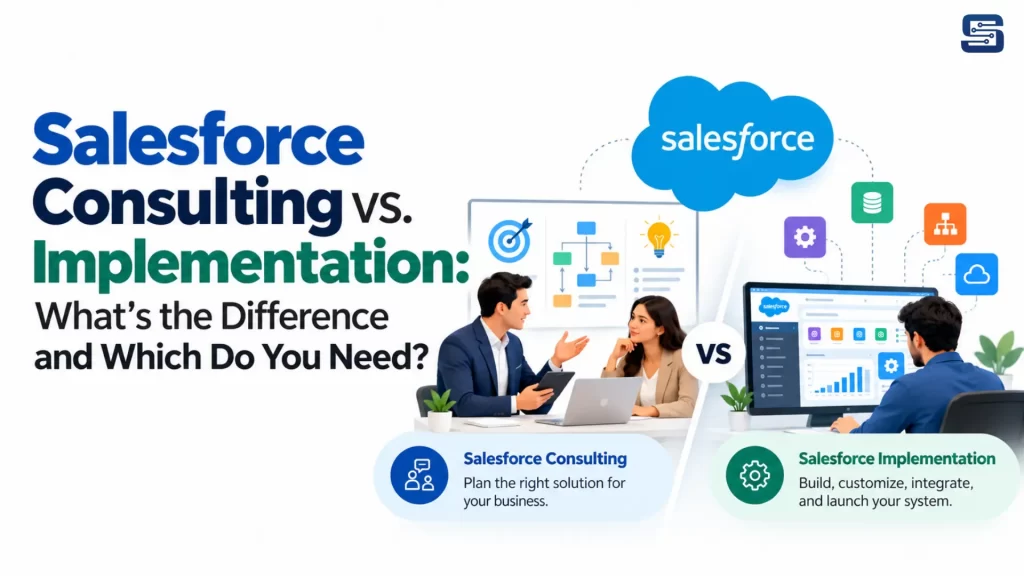
In simple terms, consulting determines what your business needs and why, while implementation builds and launches the solution. Let’s explore their differences, benefits, costs, and how to decide which service is right for your business.
What Is Salesforce Consulting?
Salesforce consulting focuses on understanding your business challenges and planning how Salesforce can address them.
A consultant evaluates your existing workflows, business goals, customer management processes, and technology systems before recommending a suitable solution.
Key Salesforce Consulting Services
- Business analysis: Identifying workflow problems, operational gaps, and opportunities for improvement.
- Requirement gathering: Understanding what employees, managers, and customers need from the system.
- Salesforce product selection: Recommending suitable products, such as Sales Cloud, Service Cloud, or Marketing Cloud.
- Solution architecture: Planning data structures, automation, integrations, and security.
- Budget and roadmap planning: Defining project scope, priorities, timelines, and estimated costs.
- Salesforce health checks: Reviewing an existing system to identify inefficiencies, unused functionality, data issues, and improvement opportunities.
Example
Suppose your sales team manages leads through spreadsheets and frequently misses follow-ups.
A Salesforce consultant studies the process and recommends a solution involving centralized lead management, automated assignments, follow-up reminders, and performance dashboards.
The consultant defines how the solution should work before the implementation team begins building it.
The primary outcome: A clear strategy, documented requirements, and an actionable implementation plan.
What Is Salesforce Implementation?
Salesforce implementation is the process of turning business requirements into a working Salesforce system.
The implementation team configures Salesforce, develops custom functionality where necessary, connects external applications, migrates data, tests the solution, and prepares it for everyday use.
Key Salesforce Implementation Services
- Configuration: Setting up objects, fields, page layouts, user roles, and permissions.
- Customization and development: Building custom functionality using tools such as Salesforce Flow, Apex, and Lightning Web Components when required.
- Workflow automation: Automating lead assignments, approvals, notifications, and routine business tasks.
- System integration: Connecting Salesforce with ERP, ecommerce, email, accounting, and other business applications.
- Data migration: Cleaning, transferring, and validating data from spreadsheets or legacy systems.
- Testing and deployment: Checking functionality, conducting user acceptance testing, and launching the system.
- Training and go-live support: Helping employees adopt Salesforce and resolve initial issues.
Example:
Following the consulting recommendations, the implementation team configures lead assignment rules, creates automated follow-up tasks, builds sales dashboards, migrates existing customer records, and tests the system with actual users.
Once the business approves the results, Salesforce is deployed for everyday use.
The primary outcome: A tested, functional Salesforce solution ready for business operations.
Salesforce Consulting vs. Implementation: Key Differences
| Factor | Salesforce Consulting | Salesforce Implementation |
|---|---|---|
| Main objective | Plan the right solution | Build and deploy the solution |
| Primary question | What should we build, and why? | How do we build it and launch it? |
| Main activities | Analysis, requirements, architecture, roadmap | Configuration, development, integration, migration |
| Key deliverables | Requirements, recommendations, solution design | Working system, tested features, deployment |
| Best starting point | Unclear needs or complex business challenges | Defined requirements and approved scope |
| Typical duration | A few weeks for focused projects | Several weeks to many months |
| Main benefit | Reduces the risk of building the wrong solution | Turns business requirements into practical functionality |
The two services can overlap. Consultants may help with technical design, while implementation teams often participate in discovery and planning. The distinction depends on the agreed scope and deliverables.
Do You Also Need Salesforce Managed Services?
Consulting and implementation are not the end of the Salesforce journey. Once the system goes live, your business may need ongoing maintenance, troubleshooting, and improvements.
Salesforce managed services provide continued support to keep the system aligned with changing business requirements.
Typical services include:
- Fixing technical issues and updating automations.
- Managing users, permissions, and system configurations.
- Monitoring integrations and resolving synchronization errors.
- Improving reports, dashboards, and data quality.
- Providing user support and implementing enhancements.
The complete Salesforce journey is straightforward: Consulting plans the solution, implementation builds it, and managed services maintain and improve it.
How Much Does Salesforce Consulting and Implementation Cost?
Salesforce costs depend on project complexity, partner rates, customization, integrations, data migration, and training requirements. The following figures are illustrative planning estimates, not official Salesforce prices or guaranteed quotations.
| Project type | Estimated service cost (USD) | Typical timeline |
|---|---|---|
| Focused consulting engagement | $5,000–$20,000 | 2–6 weeks |
| Small, single-cloud implementation | $10,000–$25,000 | 4–8 weeks |
| Mid-sized implementation with integrations | $25,000–$150,000 | 3–6 months |
| Large enterprise implementation | $150,000–$500,000+ | 6–18 months |
Actual costs may fall outside these ranges. Salesforce licenses, third-party tools, and ongoing support may be charged separately.
To control costs, define your requirements early, prioritize essential features, use standard Salesforce functionality where appropriate, and request a written proposal that clearly explains scope, exclusions, milestones, and additional charges.
Common Mistakes to Avoid
Several mistakes can reduce the value of a Salesforce investment:
1. Building without a clear plan: Unclear requirements often lead to unnecessary features and expensive rework.
2. Ignoring data quality: Incorrect or duplicated records can make reports unreliable and affect customer relationships.
3. Over-customizing Salesforce: Excessive custom code increases maintenance complexity and future upgrade effort.
4. Neglecting user training: Employees may avoid using the system if it does not fit their workflows or they do not understand it.
5. Forgetting post-launch support: Without ongoing maintenance, integrations, automations, and business processes can become less effective.
The solution is to establish clear requirements, validate the design, test thoroughly, train users, and plan for ongoing improvement.
Which Salesforce Service Does Your Business Need?
The right service depends on your current situation and how clearly your requirements are defined.
- Implementing Salesforce for the first time? Start with consulting if you need help selecting products, defining requirements, or planning your system.
- Have approved requirements and a clear design? Proceed with implementation, including any necessary technical validation.
- Already using Salesforce but experiencing problems? Begin with a health check or consulting assessment to identify the root cause.
- Adding another Salesforce product or integrating external systems? You may need both consulting and implementation to ensure the new functionality fits your existing architecture.
- Recently launched Salesforce? Consider managed services for troubleshooting, user support, and ongoing improvements.
- Merging two companies with separate Salesforce systems? Start with consulting to plan data consolidation, process alignment, and the target architecture.
When requirements are unclear, a focused discovery engagement is often a better starting point than committing immediately to a large development contract.
How to Choose the Right Salesforce Partner
A suitable Salesforce partner should understand both your business goals and the technical requirements of your project.
Before selecting a provider, consider these factors:
- Relevant expertise: Look for experience with the Salesforce products, integrations, and technologies your project requires.
- Proven results: Review case studies and examples from similar businesses or industries.
- Transparent pricing: Confirm deliverables, exclusions, change-request charges, and payment milestones.
- Clear accountability: Understand who is responsible for architecture, development, testing, migration, and deployment.
- Training and support: Check whether user training, documentation, and post-launch assistance are included.
Ask potential partners whether they provide consulting, implementation, and managed services or specialize in only one area. Their answer should help you determine whether they can support your needs throughout the project.
Conclusion
Ready to Transform Your Business with Salesforce?
At Startbit IT Solutions, we provide Salesforce consulting and implementation services tailored to your business goals, workflows, and growth plans. From choosing the right Salesforce solution to customizing workflows, integrating business systems, and implementing automation, we help you build a CRM that works for your business.
Whether you are implementing Salesforce for the first time, improving an existing system, or planning a customized solution, our team can help you move forward with a clear strategy and practical approach.
Don’t settle for a one-size-fits-all CRM. Build a Salesforce solution around your business needs.
Contact Startbit IT Solutions today to discuss your requirements and create a Salesforce consulting and implementation plan tailored to your business.
Let’s turn your Salesforce investment into measurable business value.