

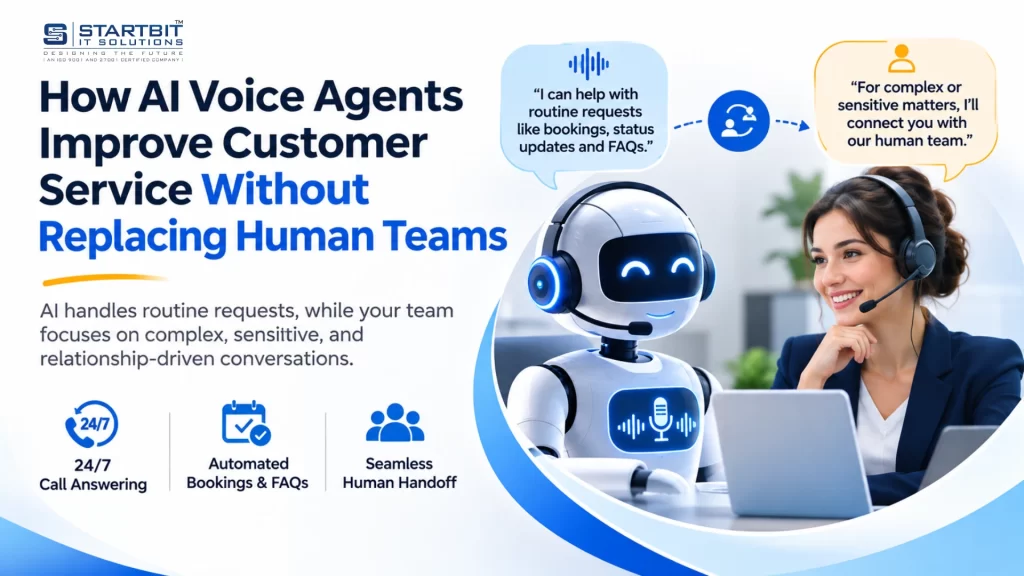
Customers today expect fast answers, short wait times and help whenever they call. They might be booking an appointment, checking an order or reporting a problem. Either way, they want the call to be quick and useful.
Meeting that expectation is hard. Support teams spend hours on the same questions, juggle incoming calls and chase follow-ups. At busy times, calls go unanswered, response times grow and customers get frustrated.
AI voice agents for customer service solve much of this. They handle routine calls, give automated support around the clock and capture every inquiry. Their real value isn’t replacing your staff. It’s giving your staff time back.
What Are AI Voice Agents in Customer Service?
An AI voice agent is software that talks with callers in natural, spoken conversation. It answers the phone, understands what the caller wants and either helps them or sends them to the right person.
Old phone menus (IVR) make you “press 1 for sales.” An AI voice agent lets callers just say what they need. It combines four technologies:
- Speech recognition (ASR): turns the caller’s words into text.
- Natural language understanding (NLU) / large language models: work out what the caller wants and pick out details such as dates, names and order numbers.
- Business integrations: connect to your calendar, CRM, order system or knowledge base so the agent can take real actions.
- Text-to-speech (TTS): answers in a natural-sounding voice.
Example: A patient calls a dental clinic and says, “Can I come in next Tuesday afternoon?” The AI voice agent checks the clinic’s schedule, offers open times and confirms the booking. No receptionist is needed.
How Do AI Voice Agents Work? (Step by Step)
- Answer: The agent picks up immediately. Calls don’t wait in a queue, even when several come in at once.
- Understand: It turns speech into text and works out what the caller wants, for example “reschedule appointment.”
- Act: It looks up information or completes a task through connected systems: checking times, finding an order or creating a ticket.
- Respond: It answers in natural speech and asks follow-up questions when details are missing.
- Escalate when needed: If the caller asks for a person, or the agent isn’t sure it understood, it transfers the call to a staff member or arranges a callback.
AI Voice Agents vs. Traditional IVR Systems
| Traditional IVR | AI Voice Agent | |
|---|---|---|
| How callers interact | Keypad menus (“Press 1…”) | Natural speech (“I need to move my appointment”) |
| Flexibility | Fixed decision trees | Understands many different ways of asking |
| Completing tasks | Mostly routes calls | Can book, update, look up and capture details |
| Follow-up questions | Not possible | Asks for missing details as needed |
| Handoff to a person | Usually a “cold” transfer with no background | A “warm” transfer with a summary of the call |
| Caller experience | Often frustrating and slow | Faster and more like talking to a person |
Why AI Voice Agents Support (Not Replace) Human Teams
AI is very good at speed, consistency and volume. It can’t truly feel empathy, handle un
usual situations with sound judgment or build long-term trust. The best results come from giving each side the work it does best.
What AI handles vs. what humans handle
| AI voice agents handle | Human teams handle |
|---|---|
| Business hours, location and service area questions | Complaints and service recovery |
| Booking, rescheduling and canceling appointments | Emotionally sensitive or personal conversations |
| Order and delivery status | Refunds, exceptions and approvals that need a manager |
| Taking down new leads and service requests | Complex technical, financial or medical questions |
| After-hours call answering | Negotiation and relationship-building |
| Sending callers to the right department | Unusual situations and judgment calls |
AI takes care of the repetitive calls
Most support lines get the same questions every day: What are your hours? Where’s my order? Can I book for Friday? Do you serve my area? If the AI agent has accurate information and the right integrations, it can resolve these right away. Callers get faster answers, and your team is freed from answering the same thing over and over.
People handle what needs judgment and empathy
A customer who has had three failed service visits doesn’t want a script. They want someone who is accountable. A patient with a sensitive health concern needs a qualified person. In these moments, empathy, context and discretion count most, and people do this far better than AI.
A well-designed AI agent knows its limits and always gives callers a clear way to reach a person.
6 Ways AI Voice Agents Improve Customer Service
1. 24/7 Customer Support
Customers call at night, on weekends and on holidays. With 24/7 AI call answering, every call is answered. The agent can answer questions, take down requests, book appointments or schedule callbacks. Staff review everything when they’re back.
Example: A home services company gets a call at 10 p.m. The AI agent records the problem, address and contact details, books the first open morning slot and texts a confirmation.
2. Fewer Missed Calls and Shorter Wait Times
Every missed call can mean a lost sale. AI voice agents answer instantly and can handle many calls at once, so customers don’t sit on hold when the phones get busy. Simple requests are resolved right away, and staff keep their time for the calls that need them.
3. Automated Answers to FAQs and Routine Questions
Using information you’ve approved, the agent answers common questions about:
- Locations and opening hours
- Product or service availability
- Pricing and service details
- Appointment, booking and cancellation policies
- Delivery and order status
Because the answers come from one approved source, every caller gets the same accurate information, whoever they would otherwise have reached.
4. Easier Appointment Booking and Follow-Ups
Clinics, salons, repair companies and consultants spend hours booking, confirming, rescheduling and canceling appointments. Once it’s connected to your scheduling software, an AI voice agent handles all of this by voice. It can also trigger reminders to cut down on no-shows.
Example: “I’d like a technician on Friday morning.” The agent checks availability, collects the address and problem details, and confirms the booking.
5. Smarter Call Routing
Few things annoy callers more than being passed between departments and repeating their story each time. AI voice agents work out why someone is calling, whether it’s billing, technical support or an existing order. They then send the call to the right team, along with a summary of the conversation, so the staff member knows the situation from the start.
6. More Time for High-Value Work
When routine calls are off their plate, your staff can focus on complex cases, key customer relationships and helping customers make decisions. The goal isn’t just answering more calls. It’s using your team’s time where it creates the most value.
How Human Handoff Works in AI Customer Service
Human handoff (or escalation) is what makes AI-powered support trustworthy. It means automation never stands between a customer and a person when they need one.
When should AI transfer a call to a person?
Set your agent to escalate when:
- The caller asks for a person
- The AI isn’t confident it understood or can resolve the request
- The caller sounds frustrated or upset
- The issue is sensitive or personal
- The request needs an exception, refund or manager’s approval
- The question involves complex technical, financial or medical matters
Never trap callers in an automated loop. A request that fails twice should go to a person automatically.
Warm transfer: passing along the conversation details
A warm transfer passes along what the AI has already collected: the caller’s name, reason for calling, booking or order number, and a short summary. The staff member picks up already knowing the situation. The customer doesn’t have to repeat themselves, and the call is resolved faster.
Collect and share this information only in line with your privacy policy, consent requirements and access controls.
Why a smooth handoff builds trust
Customers mostly care about getting their problem solved. What damages trust is not being able to reach a person when it matters. A clear, fast handoff shows that your business is still accountable and that automation is there to help customers, not to block them.
Real-World Examples by Industry
Healthcare: Appointments and Patient Questions
AI voice agents book and confirm appointments, give clinic hours and directions, and answer administrative questions after verifying the caller’s identity. Medical advice, emergencies and clinical concerns must always go to qualified staff, following established procedures.
Home Services: Never Miss a Job
Plumbers, HVAC technicians and electricians can’t answer the phone while they’re on a job. An AI agent takes down the problem, address and contact details. It then books an open slot or flags urgent jobs, such as a burst pipe, for immediate attention.
Retail and E-commerce: Orders and Store Policies
AI agents handle stock questions, delivery updates and return policies. When connected to the order system, they can give customers their order status. Staff handle disputes, complicated returns and complaints.
Professional Services: Capturing Leads and Booking Consultations
Law firms, accountants, consultants and real estate agencies use AI agents to take down inquiries after hours, answer general questions and book consultations. Every lead is captured, and advisors can spend their time with the client.
Benefits of Combining AI Voice Agents with Human Support
- Faster responses: Routine calls are answered immediately.
- Higher staff productivity: Less repetitive work, more time for complex cases.
- Consistent answers: Every caller gets the same approved information.
- 24/7 availability: Customers can reach you outside office hours.
- Scales with demand: Busy periods are handled without hiring at the same rate.
- Stronger relationships: Staff have time to give each customer real attention.
These benefits depend on accurate information, reliable integrations and ongoing human oversight.
Challenges and Best Practices
Be transparent about AI
Tell callers they’re speaking with an AI assistant. In some places this is required by law. For example:
“Hi, I’m the virtual assistant for [Business]. I can help with bookings and general questions, or connect you with our team.”
Make human support easy to reach
Callers should always be able to reach a person. If no one is available, offer a callback or record the issue for follow-up.
Protect customer data and privacy
Voice agents process personal details and call recordings. Use encryption and access controls, set data retention rules, get the consent required for recording, and follow the regulations that apply to you (such as GDPR, or HIPAA in healthcare). Check how your AI vendor handles and stores data.
Measure what matters
Track these numbers regularly:
| Metric | What it tells you |
|---|---|
| Containment rate | Share of calls fully resolved by AI |
| Escalation rate | How often calls are transferred to a person, and why |
| First-contact resolution (FCR) | Whether issues are solved on the first call |
| CSAT (customer satisfaction score) | Whether callers are happy with the experience |
| Booking accuracy | Whether appointments are recorded correctly |
| Call abandonment rate | Whether callers hang up before they get help |
Review failed conversations and your staff’s feedback each month, and update the agent whenever your services, prices or policies change.
How to Add AI Voice Agents to Your Existing Support Team
Step 1: Find your repetitive call types.
Review your call logs. Appointment scheduling, hours and location questions, and order status are usually the best place to start.
Step 2: Connect your business systems.
Integrate the agent with your CRM, scheduling platform, order management system, help desk, knowledge base and notification tools. Use proper access controls throughout.
Step 3: Define escalation rules.
Decide which calls AI handles on its own and which go to people, for example refunds, complaints and exceptions. Make sure staff know how transferred calls reach them and what information comes with them.
Step 4: Train your team, launch small and improve.
Involve staff from day one and explain how the AI supports their work. Launch with two or three types of calls, monitor the results, then expand. Front-line staff are your best source of feedback.
The Future: AI and People Working Together
As conversational AI improves, voice agents will understand more, connect to more systems and complete more tasks from start to finish. Customers will still need reassurance, judgment and creative problem-solving.
Businesses that chase full automation risk losing the trust that keeps customers coming back. The winning approach is to let AI absorb the repetitive work and give people the time and tools to deliver great personal service.
Conclusion: Better Customer Service Starts with Human + AI Collaboration
AI voice agents are changing how businesses handle calls. They answer 24/7, automate routine questions, book appointments and send callers to the right person. Success doesn’t come from removing people. It comes from using automation where it adds value and keeping people available where it matters most.
AI handles the routine. People handle the relationships. Together, they deliver better customer service.
Ready to see how an AI voice agent could fit your support team? Book a free consultation to find the calls you could automate first.