
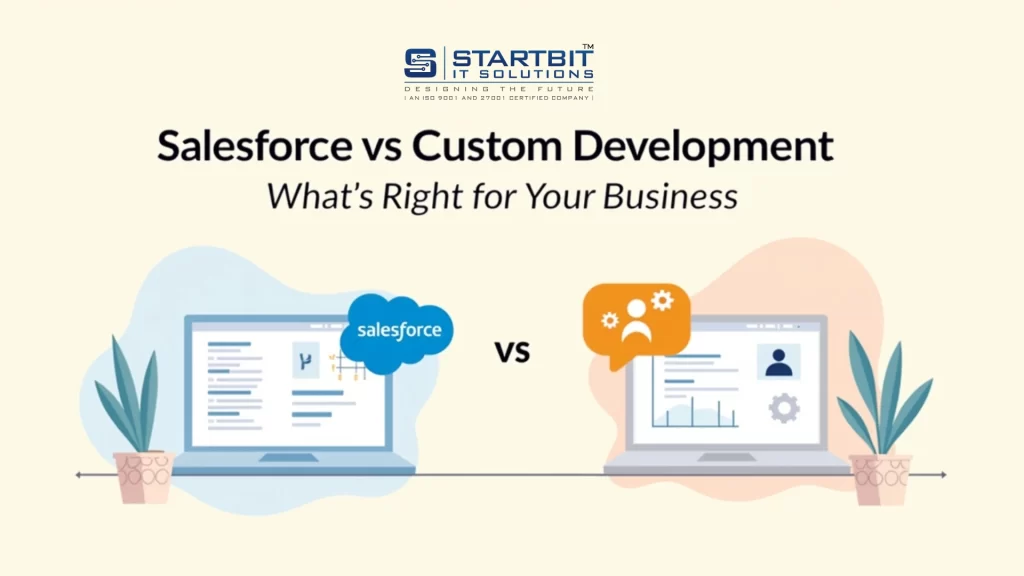
In today’s fast-moving digital era, every business faces one crucial decision:
Should we build a custom application from scratch or leverage Salesforce to power our business operations?
It’s a choice that defines how you scale, automate, and connect with customers in the long run.
At Startbit IT Solutions, we’ve worked with clients on both ends – those building custom solutions tailored to their exact needs, and those optimizing their business workflows through Salesforce’s powerful cloud ecosystem. Both have their strengths. But which one is right for you?
Let’s explore both paths in depth to help you make a confident, strategic decision.
Understanding Custom Application Development
Custom application development means designing and building software from the ground up – fully tailored to your business goals, workflows, and user experiences.
It’s like crafting a custom suit – made to fit your organization perfectly. From the database structure to the UI and integrations, every feature is aligned to your specific processes.
At Startbit, we’ve built custom applications for industries like eCommerce, logistics, real estate, and finance, where pre-built software simply couldn’t meet unique operational needs.
But before you dive into custom development, let’s break down its benefits and challenges.
Pros of Custom App Development
1. 100% Tailored to Your Business Needs
Every organization operates differently – from approval hierarchies to customer journeys. Custom apps give you complete flexibility to design solutions that match exactly how your business works.
Unlike off-the-shelf tools that make you adjust to their limitations, custom development adapts to your requirements – not the other way around.
2. Full Control and Ownership
With a custom app, you own the code, the data, and the roadmap. You decide what features to add, when to upgrade, and how to scale.
That means no dependency on third-party platforms or forced updates. Your technology evolves as your business grows.
3. Seamless Integration Possibilities
Custom applications can integrate with your existing tools – whether it’s ERP systems, payment gateways, or marketing automation tools. You’re not limited by APIs or license restrictions.
4. Long-Term Scalability
Though it takes longer to develop, a custom-built app can be easily scaled over time. You can add new modules, users, or functionalities as your business expands – all without reworking the foundation.
Cons of Custom App Development
1. High Initial Investment
Building from scratch requires significant upfront costs – design, development, testing, deployment, and hosting. While it’s a long-term asset, the initial setup can be expensive for startups or small enterprises.
2. Longer Development Cycle
Depending on the complexity, it may take several months before your custom solution is ready to launch. The process involves detailed planning, multiple testing phases, and post-deployment support.
3. Ongoing Maintenance Responsibility
Unlike cloud platforms, where maintenance is handled for you, custom applications require continuous updates, bug fixes, and performance monitoring – all managed by your team or a development partner like Startbit.
Understanding Salesforce
Salesforce is a cloud-based CRM and business automation platform that enables companies to manage sales, service, marketing, commerce, and analytics – all from one centralized system.
It’s a globally trusted solution used by over 150,000 businesses to streamline operations and build stronger customer relationships.
What makes Salesforce powerful is its ready-to-use infrastructure, low-code development tools, and scalable architecture that grows with your business.
Let’s see why Salesforce might be your ideal choice.
Pros of Leveraging Salesforce
1. Quick Implementation and Faster Time-to-Market
Salesforce’s low-code tools and pre-built components help businesses get started quickly. You can automate workflows, build custom apps with Salesforce Lightning, and deploy solutions in weeks instead of months.
2. Built-in Security and Scalability
As a cloud-based platform, Salesforce handles data security, compliance, and scalability for you. Whether you’re a 10-member team or a 10,000-member enterprise, the platform scales effortlessly.
3. Powerful CRM Capabilities
Salesforce is not just software – it’s an ecosystem designed to help you understand your customers. You can track leads, manage pipelines, personalize customer interactions, and analyze performance – all from a single dashboard.
4. Seamless Integrations with Other Tools
With Salesforce AppExchange, you can integrate thousands of third-party apps – from marketing automation tools to payment gateways – without heavy coding or manual setup.
5. Reduced Maintenance Effort
You don’t need to worry about hosting, version upgrades, or security patches. Salesforce automatically manages updates and keeps your system secure and compliant.
Cons of Leveraging Salesforce
1. Recurring Subscription Costs
Salesforce operates on a license-based model. Costs increase as you add more users, features, or premium clouds like Marketing or Service Cloud.
2. Limited Flexibility Beyond the Ecosystem
While Salesforce offers customization, it still operates within certain platform constraints. Some advanced customizations might require complex Apex coding or be limited by Salesforce’s architecture.
3. Platform Dependency
You rely on Salesforce’s updates, pricing, and infrastructure. If Salesforce changes its terms or features, your business must adapt accordingly.
Salesforce vs Custom Development: Key Comparison
| Factors | Salesforce | Custom Development |
|---|---|---|
| Setup Time | Fast, ready-to-use with low-code tools | Slower – built from scratch |
| Customization | Flexible within platform boundaries | Fully flexible and tailor-made |
| Cost Model | Subscription-based (recurring) | One-time investment (ownership) |
| Scalability | Built-in scalability | Scalable with additional development |
| Maintenance | Managed by Salesforce | Managed by your team or partner |
| Integration | Easy via AppExchange | Requires custom integrations |
| Security | Enterprise-grade, pre-configured | Custom security setup needed |
| Ownership | Salesforce owns the platform | You own the entire application |
When Should You Choose Salesforce?
Choose Salesforce when:
- You want a fast, reliable, and scalable solution with minimal setup.
- Your processes align with standard CRM functionalities.
- You prefer a subscription-based cost model over large upfront investments.
- You’re looking for integrated sales, marketing, and service automation in one ecosystem.
When Should You Choose Custom Development?
Go for custom development when:
- You need unique or complex business logic that existing tools can’t support.
- You want full control over your software, data, and roadmap.
- You aim to build proprietary features that differentiate your business.
- You have long-term scalability goals that justify higher initial investment
Startbit’s Expert Recommendation
At Startbit IT Solutions, we believe the right choice depends on your business goals, scale, and future roadmap.
If you need a rapid deployment, proven scalability, and continuous innovation, Salesforce is an excellent choice.
However, if your business demands exclusive workflows, deep customization, and ownership, custom development will deliver long-term value.
We’ve helped companies implement both – from Salesforce customization and integrations to end-to-end bespoke software development. Our experts can assess your requirements, analyze cost-benefit factors, and design a solution that aligns with your vision.
Final Thoughts
Choosing between Salesforce and custom development isn’t just a tech decision – it’s a business strategy.
Salesforce offers speed, reliability, and a vast ecosystem ready to drive your growth.
Custom development, on the other hand, gives you independence, exclusivity, and a solution built exactly for you.
If you’re still unsure which approach fits your business better – Startbit IT Solutions can help.
Our Salesforce-certified consultants and custom development teams can evaluate your goals and build the perfect roadmap to scale your business efficiently.
Frequently Asked Questions
Yes, Salesforce allows extensive customization using tools like Lightning App Builder, Apex, and Flow – though within the platform’s boundaries.
Initially, yes. Custom development requires a higher upfront investment but offers full ownership and no recurring license fees.
Absolutely. Salesforce supports thousands of integrations through APIs, AppExchange, and connectors.
If you need to launch quickly, manage customer data efficiently, and scale without heavy maintenance, Salesforce is the better choice.
Yes. Startbit IT Solutions offers Salesforce consulting and development services as well as custom software development tailored to your business requirements.