


Your eCommerce platform should help you grow – not slow you down.
But that’s what happens to many businesses. At the beginning, SaaS platforms feel easy and fast. You launch quickly and start selling.
Then your revenue grows. Your operations become more complex. And suddenly, you’re paying thousands every month for apps, dealing with customization limits, and realizing you don’t fully control the platform your business depends on.
If you’re:
- A startup founder losing margin to transaction fees
- An enterprise leader worried about rising platform costs
- An eCommerce manager stuck with rigid workflows
- A CTO tired of working around platform limitations
There is a better option.
Spree Commerce 5 is the biggest upgrade in its 16-year history. It redefines what open-source eCommerce can do – giving growing businesses more control, more flexibility, and the power to scale without limits.
What Is Spree 5 – and Why Does It Matter Now?
Spree Commerce is an open-source eCommerce platform built on Ruby on Rails, with over 15,000 GitHub stars and more than 5,000 businesses running on it – including brands like GoDaddy, Bookshop.org, and Bonobos.
Spree 5 represents a fundamental architectural evolution. It’s not a minor version bump. It’s a rebuilt foundation with a new pricing engine, customer segmentation, event-driven extensibility, headless-first APIs, and a modernized admin – all designed for the complexity that real commerce demands.
Why Open Source Matters Strategically:
Choosing open source isn’t just a technical decision. It’s a business decision about ownership, flexibility, and long-term leverage.
With a SaaS platform, every store gets the same features, the same constraints, and the same ceiling. Your ability to innovate is capped by what your vendor allows. When APIs change, you comply or break. When pricing increases, you absorb it or migrate.
Open source flips that equation. You own the code. You control the roadmap. You build proprietary IP on top of a battle-tested foundation – and that IP becomes part of your competitive moat, your valuation story, and your ability to iterate faster than competitors locked into someone else’s platform.
The Technical Foundation:
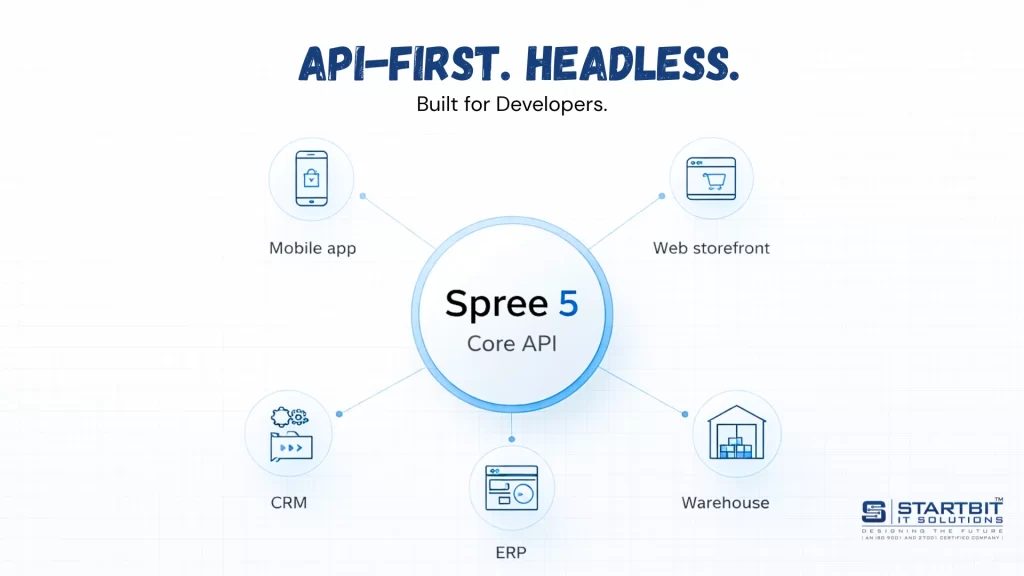
Spree 5 is API-first and modular by design. It supports headless commerce with comprehensive REST and GraphQL APIs, composable architecture where you use only what you need, deployment anywhere – cloud, on-prem, hybrid, and an extensibility model (Events & Subscribers) that lets you build custom workflows without forking core code. The latest 5.3 release adds a powerful pricing engine with price lists, customer groups for segmentation, Webhooks 2.0 with admin UI, and AI-assisted developer tooling for Cursor and Claude.
Why It Matters — By Role
For Startup Founders: Build to Own, Not to Rent:
Investors don’t like businesses that depend completely on rented platforms. When they ask if your technology is truly yours, saying you use the same system as millions of other stores isn’t very impressive.
With Spree Commerce, you fully own your commerce platform. There are no transaction fees cutting into your profits, no rising monthly SaaS costs as you grow, and no extra charges for adding more stores or customers.
For example, a typical Shopify Plus setup can cost $5,500 or more per month when you include platform fees and paid apps. With Spree, you can use that money to improve your product, grow faster, and show investors that you use your budget wisely.
You also avoid the trouble of switching platforms later when your business becomes too big for SaaS limits. If you start with Spree, you build on a system that grows with your business — not one that holds it back.
For Enterprise Decision-Makers: Control Costs, Reduce Risk, Scale Confidently:
Enterprise eCommerce is not simple. You often manage different countries, multiple currencies, B2B and DTC customers, and many sales channels – all while trying to control costs and avoid depending too much on one vendor.
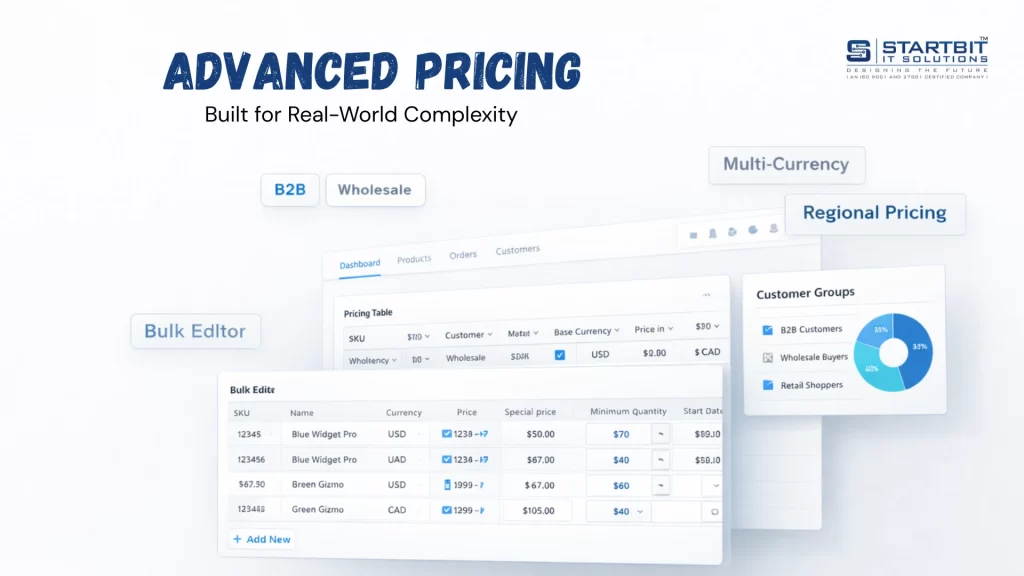
Spree Commerce 5.3 is built to handle this complexity. Its new pricing engine lets you create:
- B2B contract pricing
- Wholesale pricing tiers
- Region-based pricing
- Volume discounts
- Special prices for specific customers
And you can manage all of this directly from the admin panel – no custom coding required.
Your total cost also becomes more predictable. There are no per-transaction fees, fewer paid apps, and less reliance on third-party tools that can break or cause integration issues.
Most importantly, you control the source code. That means no surprise price increases, no forced API changes, and no sudden platform decisions that hurt your business. You stay in control.
For eCommerce Managers: Flexibility Where It Counts:
Managing daily operations on a limited platform often means finding temporary fixes again and again. Every small change requires developer support, which slows things down. With Spree Commerce, eCommerce managers can handle most tasks on their own.
Customer Groups allow you to divide customers into segments and give each group different pricing, promotions, or shopping experiences – all from the admin panel. The bulk price editor works like a spreadsheet, with simple keyboard shortcuts. You can quickly update prices across many products, currencies, and regions without needing help from developers.
Spree also includes multi-store, multi-warehouse, and omnichannel features built directly into the platform. You don’t need to rely on multiple third-party apps that may clash with each other. If you’ve ever wasted days fixing conflicts between different apps on your storefront, you understand why built-in features are much better.
For CTOs and Technical Leads: Architecture That Respects Your Team:
Spree’s architecture is designed for developers who build and maintain commerce systems at scale.
Headless-first means your frontend team can use whatever stack they prefer – Next.js, React, Vue, mobile native – consuming Spree’s APIs without being locked into a specific rendering layer.
Event-driven extensibility through the new Events & Subscribers engine lets you hook into core commerce events (order placed, payment completed, inventory updated) and build custom workflows without modifying core code. This is critical for maintainability — your customizations survive upgrades cleanly.
Webhooks 2.0 with a built-in admin UI means enterprise integrations (ERP, WMS, CRM, marketing automation) connect through a standardized, manageable interface rather than fragile custom code.
The Rails foundation means a mature ecosystem, strong testing conventions, and a large talent pool. Spree 5.2’s AI developer tooling — with rules for Cursor and Claude that encode architectural conventions – means AI-assisted development generates code that actually fits your project patterns instead of creating technical debt.
Real-World Scenario: Outgrowing SaaS:
Consider a mid-market wellness brand doing $8M in annual revenue. They launched on a SaaS platform three years ago and it worked well at first. Now they’re expanding into B2B wholesale alongside their DTC channel, launching in three new markets with localized pricing, and preparing for a Series B raise.
Their current platform costs $6,200/month when you add up the base plan, transaction fees, and the twelve app subscriptions required for functionality like wishlists, loyalty programs, and advanced shipping rules. Their development team spends 30% of their time working around platform limitations. And their investors are asking hard questions about technology differentiation.
After migrating to Spree 5, this brand consolidates their DTC and B2B operations on a single platform. Price lists handle wholesale tiers and regional pricing natively. Customer Groups drive personalized experiences without third-party tools. Monthly platform costs drop by over 60%. And their development team shifts from building workarounds to building proprietary features that directly drive conversion and retention – features that become part of the company’s IP story for investors.
Addressing Common Concerns:
Is open-source eCommerce secure?
Spree’s open-source model means its code is continuously reviewed by a global developer community. Security vulnerabilities are identified and patched faster than in closed-source systems where only the vendor’s team has visibility. Spree follows Rails security best practices and provides regular security updates. Enterprise deployments add standard infrastructure security – the same measures you’d apply to any production application.
What about support?
Spree offers an Enterprise edition with dedicated support, SLAs, and professional services. The open-source community is active on Slack and GitHub. And because Spree is built on Ruby on Rails – one of the most well-documented frameworks in existence – finding experienced developers is straightforward. You’re not locked into a single vendor for expertise.
Is implementation complex?
Spree 5 introduced a new installer that significantly reduces setup time. Generators standardize common workflows. Comprehensive documentation covers everything from initial setup to complex multi-tenant deployments. For teams already working in Rails, the learning curve is minimal. For teams new to the ecosystem, Spree’s architecture follows conventions that Rails developers worldwide understand.
Is it enterprise-ready?
Spree powers commerce for thousands of businesses, including publicly traded companies and high-traffic storefronts. It supports multi-store, multi-region, multi-warehouse, and marketplace architectures out of the box. The 5.3 pricing engine and customer groups were specifically designed for enterprise complexity. This isn’t a weekend project – it’s a platform with 16 years of production hardening behind it.
The Strategic Picture: Open Source vs. SaaS
The choice between open-source and SaaS eCommerce isn’t about one being universally better. It’s about which model aligns with your business trajectory.
SaaS platforms offer speed to market and simplicity for straightforward use cases. They work well when your requirements are standard and your growth plans are moderate.
Open-source platforms like Spree offer long-term economic advantage because costs don’t scale linearly with revenue the way percentage-based transaction fees do. They offer innovation speed because your development team can build and deploy features on their own timeline, not the platform vendor’s. And they offer strategic flexibility because your commerce infrastructure adapts to your business model rather than the other way around.

For businesses with complex requirements – multi-region operations, B2B and DTC under one roof, marketplace models, or plans to raise capital – the flexibility and ownership that open source provides isn’t just a nice-to-have. It’s a strategic advantage that compounds over time.
Whether you’re planning a new build, considering a migration from an existing platform, or exploring how to consolidate multiple commerce tools into a unified architecture, Spree’s team offers architecture assessments and migration evaluations designed to give you a clear picture of what’s involved, what the timeline looks like, and what the long-term economics mean for your business.
- Explore Spree 5: spreecommerce.org
- Review the documentation: spreecommerce.org/docs
- See the source code: github.com/spree/spree
- Start a conversation: spreecommerce.org/get-started
Conclusion
Spree Commerce 5 gives growing brands the ownership, flexibility, and scalability that SaaS platforms often limit. But choosing the right platform is only half the equation – implementing it strategically is what drives long-term success.
At Startbit IT Solutions, we help businesses unlock the full potential of Spree 5 through expert architecture planning, seamless migrations, custom development, integrations, and ongoing optimization. From startups to enterprises, our team ensures your commerce infrastructure is built to scale, secure, and evolve with your growth.
If you’re ready to move beyond platform limitations and build a commerce ecosystem you truly own, Startbit IT Solutions is here to guide you every step of the way.