
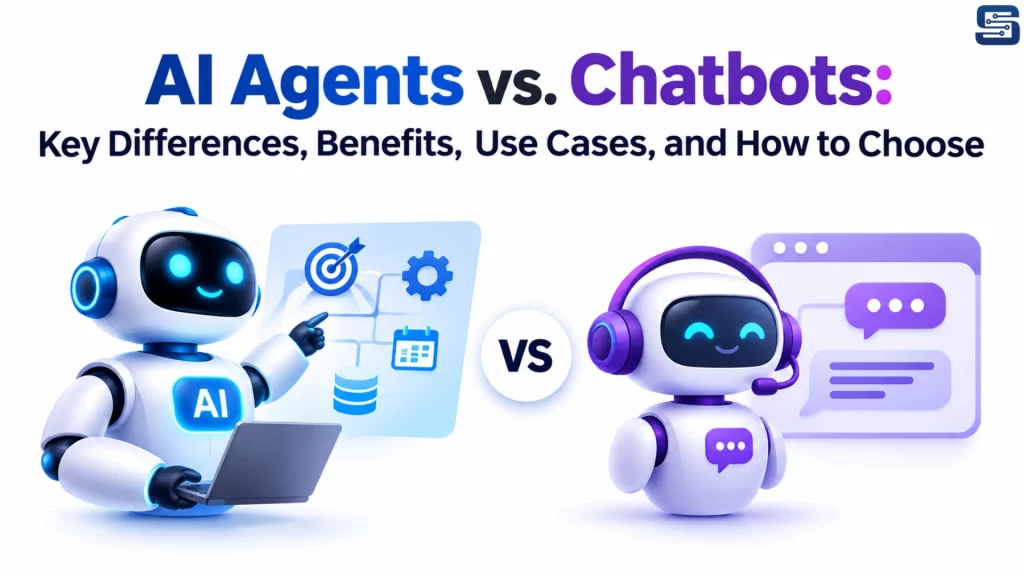
When comparing AI agents vs. chatbots, the fundamental difference lies in autonomy, decision-making, and task execution. A chatbot is a conversational AI system designed to communicate with users, answer questions, and perform configured tasks. An AI agent is a goal-oriented system that uses agentic AI capabilities such as reasoning, dynamic planning, tool calling, and multi-step workflow automation to achieve specific objectives.
While chatbots help businesses automate customer interactions, AI agents extend automation into operational processes involving multiple applications, decisions, and actions.
However, modern chatbots are not limited to scripted responses, and AI agents do not necessarily operate without human supervision. Both technologies offer distinct advantages depending on business requirements, workflow complexity, integration needs, and automation objectives.
Understanding the difference between AI agents and chatbots helps businesses make informed technology investments, improve customer experiences, reduce operational inefficiencies, and achieve measurable business outcomes.
What Is a Chatbot?
A chatbot is a software application designed to communicate with users through text or voice-based interactions. It processes user inputs and generates relevant responses using predefined rules, natural language processing (NLP), knowledge bases, or generative artificial intelligence across websites, mobile applications, messaging platforms, and customer service channels.
Depending on its capabilities and integrations, a chatbot can answer frequently asked questions, recommend products, collect customer information, track orders, schedule appointments, and transfer complex inquiries to human representatives.
How Do Chatbots Work?
Chatbots interpret user inputs and determine an appropriate response or action based on their underlying technology. Traditional chatbots rely on predefined rules, while modern AI chatbots use language models and knowledge retrieval mechanisms to support more flexible conversations.
A typical chatbot workflow involves five stages:
- Receiving user input: The chatbot receives a question or request through a text or voice interface.
- Understanding intent: Natural Language Understanding (NLU), intent classification, and entity extraction help identify the user’s objective and relevant information.
- Retrieving information: The chatbot accesses predefined responses, business knowledge bases, or connected applications. Generative AI chatbots may use Retrieval-Augmented Generation (RAG) to retrieve relevant information.
- Generating a response or action: The chatbot provides an answer or triggers a configured workflow, such as checking an order status or booking an appointment.
- Escalating when necessary: Requests outside the chatbot’s capabilities are transferred to a human representative with relevant conversation context.
Advanced chatbots can use large language models (LLMs), semantic search, embeddings, and vector databases to improve response relevance and contextual understanding.
Different Types of Chatbots
Chatbots can be categorized according to their underlying technology, conversational capabilities, and execution architecture.
Rule-Based Chatbots
Rule-based chatbots operate using predefined rules, decision trees, keywords, and structured conversation flows. Users are guided through predetermined interaction paths based on their inputs or selected options.
These chatbots are particularly effective for predictable tasks such as answering FAQs, providing business hours, collecting customer details, and directing users to relevant services.
Their primary limitation is that they may struggle with unexpected requests that fall outside their configured rules.
NLP-Based Chatbots
Natural Language Processing (NLP) chatbots use Natural Language Understanding (NLU), intent classification, and entity extraction to interpret human language.
For example, whether a customer asks, “Where is my order?” or “When will my package arrive?”, an NLP-based chatbot can recognize that both questions relate to shipment tracking.
These chatbots provide more flexible interactions than basic rule-based systems and are commonly used for customer support, product discovery, banking assistance, and appointment scheduling.
Generative AI Chatbots
Generative AI chatbots use large language models to understand user requests and generate contextually relevant responses. They can handle open-ended conversations, summarize documents, explain complex topics, and answer questions using enterprise knowledge bases.
Many business implementations use Retrieval-Augmented Generation (RAG), semantic search, and vector databases to ground responses in relevant organizational information.
When connected to external applications, generative AI chatbots can also execute configured API calls or webhooks, such as checking order statuses, updating customer details, or submitting service requests.
The architectural distinction is that a conventional chatbot typically follows predefined execution paths. An AI agent can dynamically decompose an objective into subtasks, select tools at runtime, evaluate intermediate results, and revise its execution plan.
A chatbot equipped with these agentic capabilities may also qualify as an AI agent.
Hybrid Chatbots
Hybrid chatbots combine rule-based automation, NLP, and generative AI capabilities to balance conversational flexibility with operational control.
For example, a hybrid chatbot may use generative AI to understand a customer’s request while following deterministic business rules to process an appointment booking or service cancellation.
This approach is particularly useful for organizations that require natural conversations without sacrificing consistency in critical business workflows.
Key Features of Chatbots
- Multilingual and omnichannel communication: Support text and voice interactions across websites, applications, and messaging platforms.
- Natural Language Understanding: Identify user intentions and extract relevant information from conversations.
- Knowledge base grounding: Retrieve approved information from FAQs, product documentation, help centers, and business policies.
- Conversation context management: Maintain dialogue history to deliver coherent and relevant responses across multiple conversation turns.
- Predefined task execution: Trigger configured actions such as lead capture, appointment booking, status lookups, and form submissions.
- CRM and helpdesk integration: Connect with Customer Relationship Management (CRM) and customer service platforms to manage interactions.
- Human handoff: Transfer complex inquiries to human representatives along with relevant conversation history.
- Analytics and reporting: Track conversation volumes, response times, resolution rates, and customer satisfaction.
What Is an AI Agent?
An AI agent is an artificial intelligence-powered system designed to achieve specific objectives by analyzing information, selecting actions, interacting with external tools, and executing tasks within defined operational boundaries. Modern AI agents can combine large language models, reasoning mechanisms, contextual memory, APIs, and iterative planning to coordinate complex business workflows.
Unlike conventional chatbots, which primarily follow conversational or configured execution paths, AI agents can dynamically determine how to accomplish an assigned objective.
For example, a procurement AI agent can review a purchase request, compare supplier quotations, check budget availability, identify policy exceptions, and prepare a purchase order for authorized approval.
The agent’s objective is not simply to provide information but to help achieve a defined business outcome.
How Do AI Agents Work?
AI agents use a combination of reasoning, planning, tool integration, task execution, and outcome evaluation. Rather than following a purely linear sequence, modern agents can operate through iterative reasoning-action-observation loops.
A typical AI agent workflow includes the following stages:
- Goal identification: The agent receives a user request, predefined objective, scheduled instruction, or backend business event.
- Context gathering: It retrieves relevant information from databases, documents, connected applications, and available short-term or long-term memory.
- Reasoning and task decomposition: The agent breaks the objective into smaller subtasks and determines an appropriate execution plan.
- Tool selection and function calling: It identifies suitable APIs, databases, and enterprise tools using structured tool definitions or integration protocols such as Model Context Protocol (MCP).
- Task execution: The agent invokes selected tools and performs authorized actions within established permissions.
- Outcome evaluation and feedback: It examines intermediate results. If an action fails or returns incomplete information, the agent may revise its plan, select another tool, or retry within configured limits.
- Completion or human-in-the-loop escalation: The agent completes the task, requests human approval for sensitive actions, or escalates unresolved exceptions.
Architectural approaches such as ReAct combine reasoning and action execution in an iterative process. This allows an agent to observe the results of its actions and determine appropriate next steps rather than relying exclusively on a fixed workflow.
The execution loop must remain subject to security controls, resource budgets, retry limits, and human oversight.
Different Types of AI Agents
AI agents can be classified according to their foundational decision-making models and modern implementation architectures. These classifications describe different dimensions and may overlap within a single system.
Foundational AI Agent Models
| Type of AI Agent | Description | Example Application |
|---|---|---|
| Simple Reflex Agents | Respond to predefined conditions using deterministic rules. | Threshold alerts and basic routing triggers |
| Model-Based Agents | Maintain an internal representation of their environment. | Inventory monitoring and operational tracking |
| Goal-Based Agents | Select actions designed to achieve defined objectives. | Order fulfillment and task coordination |
| Utility-Based Agents | Evaluate available options against preferred outcomes. | Resource allocation and logistics optimization |
| Learning Agents | Improve decision policies through configured learning and feedback mechanisms. | Recommendation systems and adaptive fraud detection |
Simple reflex agents represent a foundational AI concept and do not necessarily possess the reasoning or autonomous workflow capabilities associated with modern LLM-powered AI agents.
Modern Enterprise AI Agent Architectures
Single-Agent LLM Systems
These systems use an individual AI agent equipped with language models, reasoning capabilities, and external tools. They are suitable for workflows that can be managed within a single operational context, such as customer service resolution or document processing.
Multi-Agent Systems
Multi-agent architectures coordinate multiple specialized AI agents to achieve shared objectives. Different agents may handle research, data retrieval, planning, execution, or quality verification using supervisor-worker or sequential handoff patterns.
Event-Driven Background Agents
Event-driven agents operate asynchronously in response to webhooks, scheduled events, database changes, or system notifications. They can support activities such as monitoring service-level agreements, processing invoices, and coordinating operational exceptions.
Human-in-the-Loop Copilot Agents
These agents assist employees by preparing information, developing execution plans, and recommending actions. They request human approval before performing sensitive or high-impact activities.
This architecture is particularly useful for financial operations, healthcare administration, compliance workflows, and other environments where accountability is essential.
Key Features of AI Agents
- Goal-oriented reasoning and planning: Break high-level business objectives into executable subtasks and dynamically adjust execution plans.
- Dynamic tool and API orchestration: Select and invoke external applications, APIs, databases, and enterprise services at runtime.
- Multi-step workflow execution: Coordinate interconnected business processes without requiring user instructions at every stage.
- Persistent task memory: Maintain workflow progress, contextual information, and operational state across sessions when required.
- Proactive event-driven execution: Initiate tasks in response to business events, system alerts, or scheduled triggers.
- Outcome evaluation and exception handling: Inspect tool results, identify failures, and replan or escalate within defined limits.
- Human-in-the-loop governance: Enforce approval checkpoints for sensitive transactions and high-impact decisions.
- Security and observability: Apply granular permissions, execution monitoring, audit logging, and operational controls.
AI Agents vs. Chatbots: What Are the Key Differences?
The main difference between AI agents and chatbots is their execution architecture. Conventional chatbots primarily manage conversations and predefined actions, while modern AI agents can dynamically plan tasks, select tools, evaluate intermediate outcomes, and coordinate multi-step workflows to achieve specific objectives.
The following comparison focuses on conventional chatbot architectures and modern agentic AI systems.
| Comparison Factor | Chatbots | AI Agents |
|---|---|---|
| Primary objective | Conversational assistance | Goal-oriented task completion |
| Execution architecture | Predefined dialogue flows and configured actions | Iterative reasoning, planning, and execution |
| Autonomy | Operates within configured conversational workflows | Selects and adapts actions within defined permissions |
| Decision-making | Intent-based rules or contextual response generation | Goal-based reasoning and action selection |
| Task execution | Fixed workflows and predefined integrations | Dynamic task decomposition and workflow orchestration |
| Memory | Primarily conversation context and stored user information | Persistent task state, checkpoints, and optional episodic memory |
| System integration | Configured API calls and webhook triggers | Dynamic tool selection and schema-guided function calling |
| Error handling | Predefined fallback and escalation paths | Contextual replanning, bounded retries, and escalation |
| Operational triggers | Primarily user conversations and configured events | User requests, scheduled tasks, and backend business events |
| Response latency | Often optimized for individual conversational turns | Depends on the number and complexity of execution steps |
| Operational costs | Rule execution, licensing, or conversational inference costs | Model calls, tool execution, orchestration, and monitoring costs |
| Security requirements | Data protection and controlled conversational access | Additional execution permissions and transaction safeguards |
| Best suited for | Customer communication and predictable tasks | Dynamic workflows and complex business processes |
These categories are not mutually exclusive. A modern chatbot can incorporate agentic capabilities, and an AI agent can use a chatbot as its user interface.
Purpose and Functionality
Chatbots are primarily designed to facilitate communication between users and digital systems. Their functions typically include answering questions, providing recommendations, collecting information, and executing configured tasks.
AI agents focus on achieving business objectives that may require multiple decisions and actions.
For example, an employee-facing chatbot may explain a company’s onboarding policy, while an AI agent can coordinate onboarding activities across human resources, IT, and administrative systems.
Autonomy and Decision-Making
Conventional chatbots typically associate recognized user intentions with predefined responses or actions. Even when connected to external applications, their execution paths are often determined during development.
AI agents can use contextual reasoning and iterative planning to select appropriate actions at runtime. They may assess available options, evaluate intermediate results, and modify their approach when circumstances change.
This autonomy is controlled through execution boundaries, business rules, permission restrictions, and human approval mechanisms.
Contextual Understanding and Memory
Advanced AI chatbots can maintain conversation history, retrieve customer records, and use standard Retrieval-Augmented Generation (RAG) to incorporate relevant information into their responses.
AI agents can extend these capabilities through persistent task state, workflow checkpoints, episodic memory, and Agentic RAG.
Unlike conventional RAG pipelines that typically retrieve information for a response, Agentic RAG can allow a system to determine when additional information is required, refine retrieval queries, evaluate retrieved results, and select alternative data sources.
Persistent execution state also enables agents to resume interrupted workflows without restarting every task from the beginning.
Learning and Adaptability
Generative AI chatbots can adapt their responses according to immediate conversation context, user preferences, and retrieved information.
AI agents can additionally perform runtime self-correction. For example, if an API returns an unexpected result, an agent may revise its execution plan, identify an alternative action, or request additional information.
Runtime adaptation should not be confused with permanent model learning. Most deployed language models do not automatically update their underlying model weights during routine inference.
Long-term improvement generally requires controlled processes such as updating knowledge bases, refining system prompts, improving retrieval indexes, analyzing feedback, or fine-tuning models.
Task Execution and Workflow Automation
Chatbots automate conversations and configured business activities through predefined workflows. These may include single-step API calls or deterministic multi-step processes.
AI agents can manage more dynamic workflows by decomposing objectives into interdependent subtasks, evaluating branching conditions, handling exceptions, and selecting alternative execution paths.
Consider an automated business-to-business invoice reconciliation process. An AI agent could extract information from a supplier invoice, compare line items against purchase orders in an Enterprise Resource Planning (ERP) system, investigate discrepancies, and prepare approved transactions for further processing.
Unlike a fixed automation script, an agentic system can potentially adjust its approach when documents are incomplete or unexpected discrepancies occur.
Integration with Business Systems
Both chatbots and AI agents can integrate with CRM platforms, ERP software, helpdesk applications, databases, websites, and external APIs.
The important distinction is how these integrations are used.
A conventional chatbot may trigger a predefined order-status API when it identifies a shipment-tracking request. An AI agent can inspect available tool definitions, construct schema-guided function calls, select different tools based on intermediate results, and coordinate actions across multiple applications.
Technologies such as OpenAPI specifications, structured function calling, and Model Context Protocol (MCP) can support standardized tool integration.
Sensitive state-changing operations should remain subject to authorization checks and human-in-the-loop approval where appropriate.
Personalization and Customer Experience
Chatbots can personalize conversations using customer preferences, account information, previous interactions, and purchase history.
AI agents can extend personalization into operational decisions by evaluating broader business context and coordinating relevant service actions.
For example, an AI agent may identify a customer’s preferred communication channel, evaluate available service options, and coordinate an appropriate follow-up based on company policies.
Both technologies require accurate information, appropriate customer consent, and clearly defined data access policies.
Implementation Cost and Scalability
Traditional and generative AI chatbots are often more predictable in operational costs because their interactions typically involve rule execution or a limited number of model calls per conversational turn.
AI agents may require multiple model calls during planning, tool selection, execution, verification, and replanning. These additional steps can increase token consumption, API costs, infrastructure requirements, and end-to-end latency.
Enterprise AI agents may also require additional investment in:
- Workflow orchestration infrastructure
- Persistent state management
- Secure tool integrations
- Observability and monitoring
- Automated evaluation systems
- Human approval workflows
However, the additional investment can be justified when an AI agent successfully automates valuable, complex, or labor-intensive business processes.
Businesses should evaluate total cost of ownership (TCO) and cost per successful outcome rather than comparing initial development costs alone.
Traditional Chatbots vs. Generative AI Chatbots vs. AI Agents
Traditional chatbots use deterministic rules, decision trees, or intent-based NLP to manage structured conversations. Generative AI chatbots use large language models and knowledge retrieval to generate flexible responses. Modern AI agents combine AI models with iterative planning, dynamic tool calling, and task execution mechanisms to achieve defined objectives across connected systems.
| Technical Capability | Traditional Chatbots | Generative AI Chatbots | AI Agents |
|---|---|---|---|
| Core technology | Rules, decision trees, and intent-based NLP | Large language models and retrieval systems | AI models, planning loops, and tool schemas |
| Response generation | Predefined templates | Dynamically generated responses | Contextual responses and task execution |
| Knowledge grounding | Static FAQs and configured data sources | RAG and semantic knowledge retrieval | Dynamic retrieval and live multi-system information |
| Conversation handling | Structured dialogue paths | Flexible, open-ended conversations | Conversational or task-driven interactions |
| Tool invocation | Intent-mapped APIs and webhooks | Configured tool calls | Dynamic runtime tool selection |
| Execution state | Dialogue flow state | Conversation history | Persistent task state and workflow checkpoints |
| Execution control | Deterministic rules | Response generation and configured workflows | Iterative reasoning-action-observation loops |
| Failure recovery | Predefined fallback rules | Clarification and configured escalation | Bounded replanning, retrying, and escalation |
| Typical architecture | Conversation or workflow engine | LLM with knowledge retrieval | Agent runtime with tools, state, and governance |
| Example application | FAQ assistance | Knowledge-based customer support | Complex service resolution and process orchestration |
Traditional chatbots remain suitable for predictable interactions, while generative AI chatbots provide greater conversational flexibility. AI agents become particularly valuable when a business process requires dynamic reasoning, multiple tools, and adaptive execution.
Benefits of Chatbots for Businesses
Chatbots provide a practical way to improve customer communication, manage high-volume inquiries, and automate predictable interactions without introducing unnecessary operational complexity.
24/7 Customer Support
Chatbots allow businesses to provide assistance beyond normal operating hours. Customers can access product information, receive answers to common questions, and submit requests without waiting for support representatives.
This improves service accessibility, particularly for businesses operating across multiple time zones or managing high volumes of incoming inquiries.
Faster Responses to Customer Queries
Chatbots can reduce Time to First Response (TTFR) by immediately addressing common customer questions.
During peak traffic, they can manage multiple simultaneous conversations, reducing support queues and helping customers access relevant information more quickly.
Reduced Operational Costs
By resolving routine Tier-1 support requests, chatbots can reduce the number of tickets that require human intervention.
Businesses can evaluate this benefit using ticket deflection rates, containment rates, average handling time, and cost per resolved inquiry.
A well-designed chatbot can reduce unnecessary support workloads while maintaining appropriate escalation paths for complex requests.
Consistent Customer Communication
Chatbots can provide information based on approved knowledge bases, product documentation, and organizational policies.
Rule-based responses and grounded generative AI systems help reduce inconsistencies across customer service channels. Regular knowledge base maintenance remains important to ensure that responses reflect current business policies.
Simplified Automation of Routine Tasks
Chatbots provide an accessible automation layer for predictable activities such as appointment registration, service request submission, lead collection, and account status inquiries.
These structured interactions can often be automated without the additional infrastructure, reasoning costs, and operational monitoring associated with autonomous agents.
Benefits of AI Agents for Businesses
AI agents extend automation beyond conversational support by coordinating business operations, managing workflow exceptions, and reducing manual dependencies across enterprise applications.
End-to-End Business Process Automation
AI agents can coordinate entire workflows rather than automating isolated activities.
For example, an employee onboarding agent may collect required documentation, verify departmental approvals, prepare account provisioning requests, coordinate equipment allocation, and track onboarding progress.
Businesses can measure this benefit through process completion rates and reductions in end-to-end workflow cycle times.
Intelligent Decision-Making
AI agents can analyze unstructured information, evaluate available options, and determine appropriate actions based on business objectives and operational constraints.
In supply chain management, an agent could evaluate supplier availability, inventory shortages, and procurement requirements before recommending an approved purchasing option.
This approach can reduce decision-making delays while retaining human oversight where necessary.
Enhanced Operational Efficiency and Reduced Manual Workload
Employees frequently spend time transferring information between CRM systems, spreadsheets, ERP applications, and internal tools.
AI agents can reduce this manual coordination by retrieving, validating, and processing information across connected systems.
Organizations can measure improvements using Straight-Through Processing (STP) rates, employee time saved, process completion times, and reductions in manual interventions.
Personalized Customer Experiences
AI agents can coordinate personalized service workflows based on relevant customer information, account conditions, and business policies.
Rather than simply personalizing conversation responses, they can support individualized service resolutions, renewal assistance, onboarding activities, and appropriate follow-up actions.
Proactive Customer Engagement
Event-driven AI agents can initiate workflows when predefined business conditions occur.
For example, an agent may identify an upcoming subscription renewal, an incomplete onboarding process, or a pending service-level agreement (SLA) deadline and coordinate appropriate follow-up actions.
This enables businesses to address certain issues before customers need to contact support.
Improved Business Scalability
AI agents can help organizations expand automation across departments without requiring a proportional increase in repetitive administrative work.
Reusable tools, centralized governance, and standardized integrations allow businesses to extend automation into new workflows while maintaining consistent execution controls.
Scalability depends on infrastructure capacity, model efficiency, system reliability, and the ability to manage operational exceptions.
AI Agents vs. Chatbots: Real-World Use Cases and Examples
The practical difference between AI agents and chatbots becomes clearer when comparing how conventional conversational systems and agentic architectures handle the same business situations.
The following examples illustrate potential implementations across different industries.
Customer Support and Logistics Issue Resolution
Consider a customer contacting a business about an order that has not arrived.
Chatbot: A connected chatbot can retrieve live shipment tracking information, explain delivery policies, identify known status codes, and create a customer support ticket through configured integrations.
AI Agent: An AI agent can investigate the delivery exception using carrier and third-party logistics (3PL) APIs, check replacement inventory in a Warehouse Management System (WMS), evaluate available resolution options, and recommend or initiate an authorized replacement.
If replacement inventory is unavailable, the agent may evaluate alternative fulfillment locations or escalate the case.
The distinction is the ability to investigate changing conditions and dynamically coordinate an appropriate resolution rather than follow a single predefined path.
E-commerce Order and Return Management
A customer requests a return for a product that arrived damaged.
Chatbot: A chatbot can verify standard return eligibility, collect relevant information, and generate a return shipping label through a configured workflow.
AI Agent: An agent can analyze uploaded product images, retrieve order information, evaluate return policy exceptions, check replacement availability, prepare a Return Merchandise Authorization (RMA), and coordinate inventory or order management updates.
Where fraud indicators, unusual product conditions, or high-value transactions are detected, the agent can refer the case for human review.
This architecture is particularly useful for return requests involving multiple variables or exceptions to standard policies.
Healthcare Appointment Booking and Patient Scheduling
A healthcare organization needs to coordinate patient appointments involving multiple scheduling requirements.
Chatbot: A scheduling chatbot can identify available calendar slots, collect patient details, book appointments, and trigger automated reminders through predefined integrations.
AI Agent: An AI agent can coordinate approved scheduling requirements across multiple departments, verify administrative eligibility information, check specialist availability, arrange prerequisite appointments, and evaluate options when schedules conflict.
With appropriate authorization, integrations may include Electronic Health Record (EHR) systems and healthcare interoperability standards such as HL7 FHIR.
The agent can also assist with waitlist coordination and last-minute cancellation management. Clinical triage, diagnosis, and medical decisions should remain subject to qualified professional oversight.
B2B Sales Lead Qualification and CRM Routing
A prospective customer submits an inquiry about an enterprise software solution.
Chatbot: A sales chatbot can collect contact information and structured qualification details, including Budget, Authority, Need, and Timeline (BANT), before recording the lead in a CRM.
AI Agent: An agent can enrich authorized prospect information, check existing customer accounts, identify potential sales territory conflicts, prepare a discovery brief, recommend an appropriate account representative, and coordinate a meeting.
The agent may dynamically adjust its approach based on incomplete information, account ownership rules, or sales team availability.
This reduces administrative coordination and gives sales representatives more relevant information before customer conversations.
IT Helpdesk Support and Automated Incident Troubleshooting
An employee reports difficulty accessing a business application.
Chatbot: An IT support chatbot can provide approved troubleshooting instructions, guide the employee through password recovery, and create an IT service management ticket.
AI Agent: An AI agent can evaluate permitted authentication logs, inspect device compliance information, identify relevant service incidents, check software licensing conditions, and coordinate approved remediation workflows.
Integrations may include IT Service Management (ITSM) platforms and Identity and Access Management (IAM) systems.
Sensitive account changes, authentication resets, and access modifications should require appropriate verification and authorization.
The agent can document its attempted actions and escalate unresolved incidents with relevant diagnostic information.
Limitations and Challenges of AI Agents and Chatbots
Although AI agents and chatbots provide significant automation opportunities, businesses must address their technical limitations, operational risks, and security requirements before deployment.
Limitations of Traditional and AI-Powered Chatbots
Traditional chatbots may struggle with unexpected questions, ambiguous requests, and conversations outside predefined workflows.
Generative AI chatbots provide greater flexibility but can experience LLM hallucinations, where a model produces inaccurate or unsupported information that appears convincing.
Retrieval-Augmented Generation (RAG), semantic search, approved knowledge sources, and input/output validation can help reduce these risks. However, knowledge grounding does not guarantee that every generated response will be correct.
Outdated knowledge bases, ineffective escalation mechanisms, and poor contextual understanding can also negatively affect customer experience.
Limitations of AI Agents
AI agents introduce additional risks because their decisions may lead to actions across connected business systems.
Common agentic AI failure modes include:
- Incorrect tool selection: Invoking an inappropriate application or API for a given objective.
- Invalid function parameters: Generating incorrect values when constructing tool calls.
- Uncontrolled execution loops: Repeatedly attempting unsuccessful actions without appropriate stopping conditions.
- Token and resource amplification: Consuming excessive model tokens or API resources during complex workflows.
- Duplicate transactions: Repeating non-idempotent operations, potentially causing duplicate bookings or payments.
- Incomplete task execution: Updating one application while failing to complete dependent operations elsewhere.
- Excessive agency: Performing actions beyond the intended scope of authorization.
Businesses can mitigate these risks through execution limits, validation rules, idempotency keys, rollback or compensation mechanisms, scoped permissions, and human approval checkpoints.
Data Privacy and Security Challenges
Both AI agents and chatbots may process sensitive customer information, employee records, business documents, and financial data.
Enterprise implementations should incorporate security controls throughout the AI architecture.
- Role-Based Access Control (RBAC): Restrict information and tools according to authorized user and system roles.
- Least-privilege permissions: Provide only the minimum access required to complete approved tasks.
- Secure authentication: Use appropriate identity verification, scoped API credentials, and OAuth 2.0 authorization mechanisms.
- Data encryption: Protect sensitive information during transmission and storage.
- Prompt injection protection: Address malicious instructions received directly from users or indirectly through external documents, emails, and web content.
- Sandboxed execution: Restrict potentially risky tool operations to controlled environments where appropriate.
- Audit logging: Maintain records of tool calls, decisions, approvals, and state-changing transactions.
- Data minimization and retention: Limit data collection, access, storage, and retention to legitimate operational requirements.
Relevant security and governance references include the OWASP Top 10 for Large Language Model Applications, NIST AI Risk Management Framework (AI RMF), ISO/IEC 27001, and ISO/IEC 42001.
Organizations may also need to evaluate GDPR, CCPA, HIPAA, PCI DSS, the EU AI Act, and other applicable legal or industry requirements depending on their location, activities, and data processing practices.
Using these frameworks as design references does not automatically establish regulatory compliance or certification.
Integration and Implementation Complexity
Connecting AI systems with existing business applications can introduce technical challenges involving inconsistent data formats, legacy infrastructure, authentication requirements, and unreliable APIs.
AI agents may require additional capabilities such as workflow checkpoints, event-driven orchestration, state synchronization, API retry policies, and transaction compensation.
Organizations should establish reliable integration contracts and clearly documented execution boundaries before deploying complex agentic workflows.
Accuracy, Reliability, and Human Oversight
AI-generated outputs and execution plans are not always accurate. Businesses should establish validation mechanisms that assess both conversational accuracy and task execution reliability.
For high-impact activities, human-in-the-loop (HITL) approval can provide an additional layer of oversight. This may include financial transactions, sensitive account changes, regulated workflows, or actions exceeding predefined risk thresholds.
Effective governance also requires execution step limits, token budgets, monitoring dashboards, and clear escalation procedures.
The objective is to improve operational efficiency without sacrificing accountability, security, or necessary human judgment.
AI Voice Agents vs. Chatbots: Beyond Text-Based Conversations
Voice and text describe communication channels, while agentic AI describes how a system reasons, makes decisions, and executes tasks.
A chatbot can operate through text or voice, and an AI agent can also use either communication channel. The meaningful distinction is whether the system follows structured conversational workflows or dynamically coordinates actions toward a defined objective.
What Are AI Voice Agents?
AI voice agents are intelligent systems that communicate through natural spoken conversations using speech recognition, language models, and speech generation technologies. When equipped with agentic capabilities and external tool integrations, they can also coordinate authorized tasks such as appointment scheduling, customer service resolution, and multi-step business workflows.
Unlike traditional touch-tone Interactive Voice Response (IVR) systems or scripted voicebots, modern AI voice agents can support more flexible spoken interactions and dynamically select appropriate backend actions.
A typical voice AI architecture may include:
- Automatic Speech Recognition (ASR): Converts spoken language into machine-processable input.
- Large language models: Interpret requests, maintain conversational context, and generate responses.
- Text-to-Speech (TTS): Produces natural-sounding spoken output.
- Voice Activity Detection (VAD): Detects speech activity and supports conversational turn-taking.
- Barge-in handling: Allows users to interrupt or correct the system during spoken responses.
- Telephony integration: Connects AI systems with SIP, Voice over Internet Protocol (VoIP), and contact center platforms.
Some modern implementations use native speech-to-speech models instead of separate speech recognition and synthesis pipelines.
How AI Voice Agents Automate Customer Communication
AI voice agents can help businesses manage inbound calls and authorized outbound communication while integrating spoken interactions with operational workflows.
Common business applications include:
- Automated call answering: Respond to incoming calls and provide relevant business information around the clock.
- Appointment scheduling: Check availability, coordinate bookings, and manage approved rescheduling requests.
- Lead qualification: Collect prospect requirements and update sales systems during customer conversations.
- Customer service assistance: Retrieve account information and coordinate appropriate support workflows.
- Automated reminders: Deliver appointment or service reminders in accordance with communication policies.
- CRM synchronization: Record relevant call information and update authorized customer records.
- Call summaries and reporting: Generate structured summaries for operational monitoring and follow-up activities.
- Context-preserving human transfers: Route complex calls to human representatives along with relevant conversation information.
Businesses in healthcare, real estate, hospitality, professional services, and home services can use voice-based automation to improve accessibility and reduce missed customer interactions.
Outbound calling, call recording, and data processing must follow applicable consent and communication requirements.
Voice-Based vs. Text-Based AI Interactions
| Comparison Factor | Text-Based AI | Voice-Based AI |
|---|---|---|
| Communication channel | Written messages | Spoken conversations |
| Traditional baseline | Rule-based chat widgets | Touch-tone IVR and scripted voicebots |
| Modern implementation | Generative AI chatbots and text agents | Conversational voicebots and AI voice agents |
| Input processing | Text and structured user inputs | ASR or native speech understanding |
| Output generation | Written responses | TTS or native speech generation |
| Agentic capabilities | Available through planning and tool integration | Available through planning and tool integration |
| Primary integrations | Websites, apps, messaging, and APIs | SIP, VoIP, contact centers, and business APIs |
| Technical considerations | Response accuracy and context management | Turn-taking latency, speech quality, interruptions, and background noise |
| Common applications | Website support and digital workflows | Telephone support and voice-based automation |
The selection between text and voice should be based on customer preferences, communication channels, accessibility requirements, and operational objectives rather than assumptions about which interface is inherently more intelligent.
Can AI Agents and Chatbots Work Together?
Yes, AI agents and chatbots can work together within a hybrid AI architecture. A chatbot can manage customer-facing conversations, while a backend AI agent coordinates complex workflows, selects enterprise tools, and executes authorized actions. This approach combines conversational accessibility with operational automation, security isolation, and flexible system integration.
Combining Conversational AI with Agentic AI
Enterprise organizations can separate conversational interfaces from backend agent execution to improve security, maintainability, and system reuse.
A public-facing chatbot does not need direct write access to sensitive financial or ERP databases. Instead, it can submit structured requests to a controlled backend agent operating within authorized permissions.
This separation can provide several advantages:
- Security isolation: Restrict direct access to sensitive business systems.
- Asynchronous execution: Maintain responsive conversations while complex backend tasks are processed.
- Omnichannel reuse: Allow website chatbots, mobile applications, and voice interfaces to access shared backend automation.
- Centralized governance: Apply consistent permissions, monitoring, and execution controls across different customer channels.
Creating Hybrid AI-Powered Workflows
Consider an e-commerce customer requesting a product exchange involving availability and pricing conditions.
A hybrid AI workflow may operate as follows:
- Request identification: The chatbot authenticates the customer and identifies the exchange request.
- Structured context collection: Relevant details such as order ID, product identifier, and exchange reason are collected and passed to the backend through a structured JSON payload or event interface.
- Backend agent orchestration: The AI agent retrieves order information, verifies exchange eligibility, checks inventory, and evaluates applicable pricing conditions.
- Resolution preparation: The agent prepares available options, including conditional inventory reservations or payment differences, and returns structured results to the chatbot.
- Customer confirmation: The chatbot presents available options and obtains the customer’s approval.
- Authorized execution: The backend agent completes permitted actions across the Order Management System (OMS), inventory platform, and other connected services.
- Confirmation and monitoring: The system verifies the transaction outcome, communicates confirmation, and records relevant execution details.
If an exception occurs, the workflow can transfer the conversation transcript, structured customer details, and relevant diagnostic logs to an authorized human representative.
This allows customers to receive assistance without unnecessarily repeating information.
Improving Human-AI Collaboration
Effective AI implementation involves assigning responsibilities according to the strengths of each technology.
Chatbots can manage high-volume conversations, AI agents can coordinate dynamic operational workflows, and human professionals can handle sensitive decisions, complex exceptions, relationship management, and accountability.
Rather than replacing employees indiscriminately, businesses can use hybrid AI architectures to reduce repetitive work and support more effective human decision-making.
How to Choose Between an AI Agent and a Chatbot for Your Business
Choose a chatbot when your primary objective is answering customer questions, collecting information, or automating predictable interactions. Choose an AI agent when business workflows require dynamic reasoning, multi-step task coordination, external tool selection, and exception handling. For fixed backend processes, deterministic workflow automation may be more suitable than either option.
Define Your Business Goals
Start by identifying the business outcome you want to achieve.
If your primary goal is improving customer communication, reducing FAQ-related support tickets, or capturing leads, a chatbot may provide sufficient functionality.
If your objective is coordinating activities across multiple business systems or managing complex operational exceptions, an AI agent may be more appropriate.
Clearly defined business goals prevent unnecessary technical complexity and help establish meaningful performance indicators.
Evaluate Your Workflow Complexity
Not every multi-step workflow requires an AI agent.
Predictable backend processes can often be automated using Robotic Process Automation (RPA), integration Platform as a Service (iPaaS), or deterministic workflow engines.
Platforms such as Zapier, Make, UiPath, and n8n can support structured integrations where execution rules and conditions are known in advance.
AI agents become more valuable when workflows involve:
- Unstructured documents or natural language requests
- Unpredictable operational conditions
- Dynamic tool selection
- Complex exceptions and branching decisions
- Evaluation of alternative execution paths
For processes requiring strict reproducibility, deterministic controls should remain central even when AI is used to interpret inputs.
Identify the Required Level of Autonomy
Determine how independently the system needs to operate.
A conversational chatbot may provide information or execute predefined activities. A copilot agent may recommend actions for employee approval, while an autonomous agent may coordinate broader workflows within established permissions.
Consider response-time requirements, task complexity, operational risks, and whether asynchronous execution is acceptable.
Greater autonomy generally requires stronger governance, observability, and execution safeguards.
Assess Integration Requirements
Evaluate the number and complexity of the applications that the solution must access.
A chatbot may require a knowledge base, CRM platform, or scheduling API. An AI agent may need to coordinate information across ERP systems, databases, document repositories, payment platforms, and operational tools.
Review whether integrations require read-only access, state-changing actions, persistent workflow state, or transaction compensation mechanisms.
Consider Budget and Expected ROI
Evaluate the total cost of ownership rather than focusing solely on initial development expenses.
Chatbot costs may include platform licensing, conversational model usage, hosting, and knowledge base maintenance.
AI agent costs may additionally include:
- Multiple model calls per task
- Dynamic tool execution
- Workflow orchestration infrastructure
- Persistent state management
- Security and observability
- Automated evaluation and monitoring
- Human approval processes
Businesses should compare these expenses against measurable outcomes such as employee time saved, process completion rates, reductions in manual work, and cost per successful resolution.
Evaluate Security and Human Oversight Requirements
Identify the information that the AI system will access and the actions it will be permitted to perform.
Sensitive workflows may require scoped permissions, authentication, approval checkpoints, transaction limits, audit logs, and human review.
The selected architecture should align with organizational security policies and applicable legal or industry requirements.
AI Agent vs. Chatbot: Business Decision Matrix
| Business Requirement | Recommended Solution | Integration Depth | Governance Requirements |
|---|---|---|---|
| Answer routine FAQs | Rule-Based or NLP-Based Chatbot | Knowledge base access | Predefined responses and escalation |
| Handle open-ended customer questions | Generative AI Chatbot with RAG | Knowledge retrieval and configured lookups | Grounding and response validation |
| Manage structured appointments | Hybrid Chatbot | Scheduling API read/write access | Booking validation and permissions |
| Automate predictable backend workflows | RPA or iPaaS | Configured multi-system integrations | Deterministic execution and logging |
| Coordinate dynamic service requests | AI Agent | Multi-system read/write access | Scoped permissions and execution limits |
| Assist with sensitive business decisions | Human-in-the-Loop AI Agent | Controlled enterprise integrations | Mandatory approval checkpoints |
| Handle customer telephone calls | Voicebot or AI Voice Agent | Telephony, CRM, and booking integrations | Consent, monitoring, and escalation |
| Combine conversations with backend automation | Hybrid Chatbot and AI Agent | Enterprise-wide controlled integrations | Centralized governance and auditing |
The most effective solution is the one that delivers the required business outcomes with acceptable costs, operational complexity, and risk.
How to Successfully Implement AI Agents and Chatbots
Successful AI implementation requires a structured approach that combines business objectives, data preparation, integration architecture, security controls, and measurable performance evaluation.
Identify Automation Opportunities
Analyze existing business operations to identify repetitive tasks, customer service challenges, manual coordination, and recurring process delays.
Assess each opportunity according to its business value, execution complexity, data availability, integration readiness, and operational risk.
Begin with clearly defined use cases that can demonstrate measurable improvements before expanding into more complex workflows.
Select the Right AI Technology
Choose between traditional chatbots, generative AI chatbots, deterministic workflow automation, AI agents, voice-based systems, and hybrid architectures.
Consider whether the use case requires conversation management, information retrieval, fixed execution rules, or dynamic reasoning.
For AI agents, evaluate the need for single-agent architectures, multi-agent orchestration, persistent state management, and human approval mechanisms.
Prepare Business Data and Knowledge Bases
Reliable AI solutions depend on accurate, relevant, and accessible information.
Organize approved business documents, FAQs, product information, operational procedures, customer service policies, and authorized data sources.
For generative AI systems, a RAG architecture may include:
- Document processing and chunking
- Semantic embeddings
- Vector database indexing
- Metadata-based access filtering
- Retrieval relevance evaluation
- Knowledge source updates
- Response grounding and verification
Access controls should ensure that users and agents retrieve only information they are authorized to access.
Integrate Existing Business Systems
Connect the AI solution with relevant CRM, ERP, e-commerce, helpdesk, scheduling, and database platforms.
Structured tool definitions, OpenAPI specifications, function calling, and Model Context Protocol can support standardized integrations.
Enterprise integrations should also include:
- Least-privilege access permissions
- API schema validation
- Sandboxed testing environments
- Idempotency safeguards
- Execution time and step limits
- Transaction logging
- Rollback or compensation procedures
- Human approval gates
These controls are particularly important when AI agents can modify operational records or execute sensitive transactions.
Test, Deploy, and Monitor Performance
Before production deployment, evaluate the system against representative business scenarios, ambiguous requests, invalid inputs, integration failures, and unexpected operational conditions.
Use automated evaluation harnesses, security red-teaming, and controlled pilot deployments to identify potential weaknesses.
For high-risk agentic workflows, shadow-mode testing can help evaluate proposed actions without allowing the system to modify production data.
Once deployed, continuously monitor conversational quality, execution accuracy, operational costs, security events, and customer satisfaction.
Key Performance Metrics for Chatbots and AI Agents
| Performance Metric | Applies To | Measurement Method |
|---|---|---|
| Containment Rate | Chatbots | Conversations successfully resolved without human handoff divided by eligible conversations |
| First-Contact Resolution (FCR) | Chatbots and Voice Agents | Requests resolved during the first interaction divided by total eligible requests |
| Average Response Latency | Both | Average time required to produce a response or initiate an action |
| Customer Satisfaction (CSAT) | Both | Customer feedback collected after completed interactions |
| Groundedness Rate | Generative AI Systems | Responses supported by verified source information divided by evaluated responses |
| Hallucination Rate | Generative AI Systems | Responses containing unsupported or incorrect claims divided by evaluated responses |
| End-to-End Task Completion Rate | AI Agents | Successfully completed workflows divided by attempted workflows |
| Tool-Call Accuracy | AI Agents | Correct tool selections and valid executions divided by evaluated tool calls |
| Multi-Trial Reliability | AI Agents | Frequency of successful and consistent outcomes across repeated evaluations |
| Exception and Rollback Rate | AI Agents | Workflows requiring exception handling or compensation divided by executed workflows |
| Straight-Through Processing Rate | AI Agents | Eligible processes completed without manual intervention divided by total eligible processes |
| Cost per Successful Outcome | Both | Total operational costs divided by successfully completed tasks or resolved requests |
| Employee Time Saved | Both | Difference between measured manual processing time and AI-assisted processing time |
Performance targets should be established using business-specific requirements, historical baselines, task complexity, and acceptable risk levels rather than relying on universal benchmarks.
The Future of AI Agents and Chatbots
As enterprise AI adoption evolves, developments in interoperability, model efficiency, execution monitoring, and governance are influencing how organizations build conversational and agentic systems.
Standardized Agent Interoperability Protocols
Standards such as Model Context Protocol (MCP) and Agent-to-Agent (A2A) communication aim to simplify how AI systems interact with tools, external data sources, and other agents.
These approaches can reduce some of the complexity associated with custom integrations and support more modular enterprise AI architectures.
Secure implementation, authentication, authorization, and compatibility testing remain essential when connecting systems across organizational boundaries.
Domain-Specific Small Language Models
Businesses do not necessarily need large, general-purpose AI models for every automation task.
Small Language Models (SLMs) can support specialized activities such as intent classification, information extraction, tool routing, and structured response generation.
Larger reasoning models can then be reserved for complex exception handling or tasks requiring broader analytical capabilities.
This approach may improve operational efficiency by balancing model performance, latency, infrastructure requirements, and inference costs.
Multi-Agent Orchestration and Specialized Automation
Multi-agent architectures allow organizations to distribute responsibilities across specialized systems.
For example, separate agents may handle information retrieval, document analysis, operational planning, and execution verification.
Effective orchestration requires clear role definitions, shared state management, reliable communication, and mechanisms to prevent unnecessary coordination overhead.
Businesses should evaluate whether a multi-agent architecture provides measurable advantages over a simpler single-agent implementation.
Multimodal and Real-Time Voice AI
AI systems are expanding beyond text-based interactions to support spoken conversations, images, documents, and other information formats.
Multimodal capabilities can support workflows involving product inspections, document processing, customer service, field operations, and administrative coordination.
Real-time voice systems can further improve accessibility through more natural conversational turn-taking, interruption handling, and context-aware communication.
AI Governance, Observability, and Cost Optimization
As AI agents gain controlled access to business systems, organizations will need stronger mechanisms for monitoring their behavior and managing operational expenses.
Agent observability, execution tracing, token budget controls, model routing, audit trails, and AI-focused financial operations (FinOps) can help businesses manage performance and cost.
Governance frameworks such as the NIST AI Risk Management Framework can also help organizations evaluate risks, accountability, and operational reliability throughout the AI lifecycle.
Conclusion
AI agents and chatbots provide different but complementary approaches to intelligent automation. Chatbots are particularly effective for conversational assistance and predictable customer interactions, while AI agents extend automation into dynamic reasoning, tool selection, exception handling, and complex workflow execution.
Businesses should choose technology based on measurable objectives, process complexity, integration requirements, operational costs, and security considerations. By combining conversational AI, agentic AI, deterministic automation, and human expertise where appropriate, organizations can build reliable and scalable systems that deliver meaningful business value.
Build Intelligent AI Solutions with Startbit IT Solutions
The right AI strategy starts with understanding your business challenges, not simply selecting the latest technology.
At Startbit IT Solutions, we help businesses explore and develop customized AI-powered solutions aligned with their operational requirements, customer expectations, and automation objectives.
Our AI development solutions include:
- Custom AI Agent Development: Goal-oriented AI solutions incorporating contextual reasoning, RAG, function calling, and secure business system integrations.
- AI Chatbot Development: Rule-based, NLP-powered, generative AI, and hybrid chatbots for websites, mobile applications, and customer support platforms.
- AI Voice Agent Development: Voice-enabled solutions for customer call answering, appointment scheduling, lead qualification, reminders, and follow-up communication.
- Multi-Agent Systems and Workflow Orchestration: Collaborative AI architectures designed to coordinate specialized tasks and complex cross-departmental workflows.
- Retrieval-Augmented Generation (RAG) Solutions: Knowledge-grounded AI applications that retrieve relevant information from authorized enterprise documents and data sources.
- Business Process Automation: Customized solutions combining intelligent automation with deterministic workflows to reduce repetitive operational activities.
- CRM and ERP Integration: Connecting AI applications with existing business platforms to support secure, coordinated information processing and workflow execution.
- Enterprise AI Development: Custom AI solutions designed around organizational requirements, scalability objectives, security considerations, and human oversight.
Whether you need a chatbot to improve customer support, an AI voice agent to manage customer calls, or an intelligent AI agent to coordinate complex business workflows, our team can help you evaluate the right approach for your organization.
Ready to move from conversations to intelligent business automation?
Contact Startbit IT Solutions today to discuss your AI requirements, explore suitable automation opportunities, and request a customized AI development roadmap for your business.