
A business receives hundreds of customer enquiries, processes invoices, manages appointments, and updates records every day. While many of these tasks can be automated using predefined rules, others require understanding, decision-making, and problem-solving.
This is where the difference between agentic AI and traditional automation becomes important.
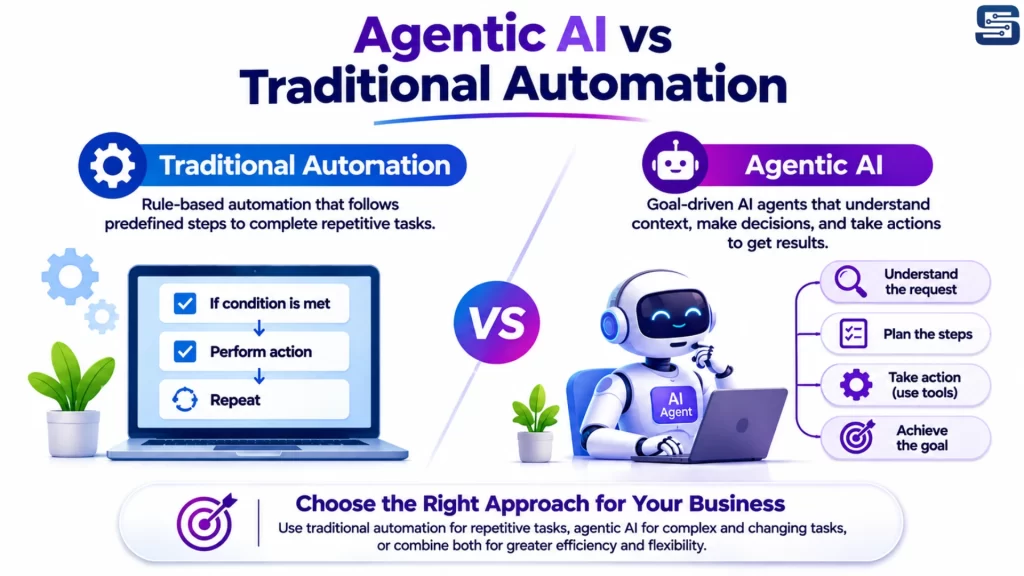
Traditional automation follows predefined instructions to complete tasks, while agentic AI can understand context, plan actions, and respond to changing situations within defined boundaries.
Both technologies can help businesses reduce manual work, improve productivity, and manage operating costs. However, choosing the wrong approach can introduce unnecessary expenses, complexity, and operational risks.
In this guide, we explore how both technologies work, their key differences, practical applications, costs, and how businesses can combine them to build smarter and more reliable operations.
What Is Traditional Automation?
Traditional automation is the use of software, predefined rules, and workflows to perform tasks automatically with minimal human involvement.
It operates according to instructions established by developers or business teams. When a specific event occurs or a condition is met, the system performs the corresponding action.
For example, when a customer places an order on an eCommerce website, an automated system can send an order confirmation, generate an invoice, update inventory, and notify the shipping department.
Every action follows a predefined process. If an unexpected situation occurs that the system has not been configured to handle, it may require human assistance.
Common Types of Traditional Automation
| Automation Type | Business Application |
|---|---|
| Rule-based automation | Sending payment reminders based on due dates |
| Robotic Process Automation (RPA) | Entering information into business software |
| Workflow automation | Managing employee leave approvals |
| Scheduled automation | Performing daily database backups |
| API-based automation | Synchronizing information between CRM and ERP systems |
| Business process automation (BPA) | Managing employee onboarding processes |
Benefits of Traditional Automation
- Reduces repetitive manual work.
- Delivers consistent and predictable results.
- Minimizes errors associated with manual data entry.
- Improves processing speed and productivity.
- Offers predictable operating costs for simple workflows.
- Makes predefined business processes easier to monitor.
Limitations of Traditional Automation
Traditional automation can struggle when information is incomplete, customer requests are unusual, or business conditions change unexpectedly.
It also requires developers or administrators to update rules when business requirements change. As the number of rules and exceptions increases, workflows can become more difficult to maintain.
Traditional automation remains a reliable choice for businesses with structured and predictable processes.
What Is Agentic AI?
Agentic AI is an artificial intelligence approach that enables AI agents to work toward specific goals by understanding information, planning tasks, selecting actions, and using available tools.
Unlike traditional automation, agentic AI can determine which steps are needed instead of always following a fixed sequence.
For example, an AI customer service agent can understand a customer’s complaint, retrieve order information, review company policies, recommend a solution, and escalate the request when human assistance is required.
Its ability to handle changing situations makes agentic AI useful for business processes that require flexibility. However, its actions remain dependent on the tools, permissions, information, and instructions provided by the business.
How Does an AI Agent Work?
An AI agent typically operates through six stages:
- Understand: Receives and interprets a request or business goal.
- Analyse: Reviews relevant information and available resources.
- Plan: Determines which actions are required.
- Act: Uses approved tools, APIs, or business applications.
- Evaluate: Checks whether the actions produced the expected result.
- Adjust: Selects another approach or requests human assistance if necessary.
For example, an AI appointment booking agent can understand a customer’s preferred date, check availability, suggest alternatives, confirm the appointment, and send booking details.
Main Components of an AI Agent
| Component | Purpose |
|---|---|
| AI model | Understands information and supports decision-making |
| Goals and instructions | Defines what the agent should achieve |
| Knowledge base | Provides access to relevant business information |
| Memory and context | Retains relevant information when required |
| Tools and APIs | Connects the agent with business applications |
| Guardrails | Defines permitted and restricted actions |
| Human oversight | Allows employees to review important decisions |
What Agentic AI Is NOT
Agentic AI is not simply a chatbot that answers questions or a generative AI tool that creates content.
It is also not a replacement for every employee, a guarantee of accurate decisions, or a system that should operate without restrictions.
A well-designed AI agent works within clearly defined business rules, permissions, and safety controls.
Traditional AI vs Generative AI vs Agentic AI
These technologies serve different purposes and can complement one another.
| Feature | Traditional AI | Generative AI | Agentic AI |
|---|---|---|---|
| Main purpose | Prediction and classification | Content generation | Goal-based task completion |
| Capabilities | Identifies patterns | Generates new content | Plans and performs actions |
| Output | Predictions or classifications | Text, images, audio, or code | Actions and task results |
| Business example | Detecting suspicious transactions | Writing customer emails | Investigating and escalating suspicious transactions |
In simple terms, traditional AI helps businesses predict, generative AI helps businesses create, and agentic AI helps businesses act.
Agentic AI vs Traditional Automation: Key Differences
The main difference between agentic AI and traditional automation is how tasks are completed. Traditional automation follows predefined instructions, while agentic AI can select and adjust actions based on the situation.
| Feature | Traditional Automation | Agentic AI |
|---|---|---|
| Working approach | Rule-based | Goal-based |
| Decision-making | Predefined conditions | Context-based decisions |
| Flexibility | Limited to configured rules | Can adapt within approved boundaries |
| Data processing | Mainly structured information | Structured and unstructured information |
| Unexpected situations | Requires predefined exception handling | Can evaluate alternative actions |
| Autonomy | Follows configured workflows | Variable levels of autonomy |
| Development cost | Often lower for simple processes | Depends on complexity and integrations |
| Operating cost | Generally predictable | May vary based on AI usage |
| Processing speed | Usually faster for simple tasks | May require additional processing |
| Accuracy | Consistent when rules and inputs are correct | Depends on model and data quality |
| Maintenance | Rules and workflow updates | AI evaluations, monitoring, and system updates |
| Best suited for | Repetitive and predictable tasks | Complex and changing business tasks |
Neither technology is universally better. The right choice depends on the nature of the task, business requirements, and the consequences of incorrect decisions.
A Practical Example: One Task, Three Approaches
Imagine an eCommerce business receives the following customer message:
“I received the wrong product and need a replacement before Friday because it is a birthday gift.”
Here is how three different automation approaches could handle this request.
Approach 1: Traditional Automation
The system identifies relevant keywords, creates a support ticket, sends an acknowledgment email, and assigns the request to an employee.
The employee then checks the order details, replacement policy, product availability, and delivery options.
Result: Routine administrative work is automated, but an employee must resolve the customer’s problem.
Approach 2: Agentic AI
An AI agent understands the complaint and recognizes the urgency of the request. It checks the customer’s order, reviews the replacement policy, verifies product availability, and evaluates shipping options.
Based on its permissions, it recommends or initiates an approved replacement.
Result: The customer may receive faster and more personalized assistance, but appropriate safeguards are required.
Approach 3: Hybrid Automation
The AI agent understands the complaint and recommends a suitable solution. Traditional automation validates replacement eligibility, processes the approved request, updates inventory, and sends confirmation.
An employee reviews cases that fall outside the company’s policies.
Result: The business benefits from intelligent customer support, reliable execution, and appropriate human control.
For this example, hybrid automation offers a practical balance between flexibility and reliability.
Which Costs More: Agentic AI or Traditional Automation?
Traditional automation is often more affordable for straightforward tasks because it does not require ongoing AI model processing.
Agentic AI may involve additional expenses related to AI model usage, software integrations, testing, security, and performance monitoring.
However, traditional automation can also become expensive when businesses need to build and maintain complex workflows with numerous rules and exceptions.
Anthropic’s guidance on building AI agents highlights that agent-based systems can introduce additional cost and processing time. Businesses should introduce that complexity only when it improves task outcomes.
Cost Comparison
| Cost Factor | Traditional Automation | Agentic AI |
|---|---|---|
| Initial development | Often lower for simple workflows | Depends on agent complexity |
| Software licensing | Automation platform expenses | AI and software platform expenses |
| Operating costs | Generally predictable | Usage-dependent |
| Integrations | Depends on existing software | Depends on required tools and APIs |
| Maintenance | Workflow and rule updates | AI testing, monitoring, and updates |
| Human involvement | Required for unresolved exceptions | May be reduced for suitable tasks |
The most important consideration is not simply the initial development cost. Businesses should evaluate the total cost of ownership and the value generated over time.
5 Ways to Control AI Agent Costs
- Use AI only where necessary: Avoid introducing AI into tasks that simple automation can handle efficiently.
- Choose appropriate AI models: Use smaller, cost-effective models for straightforward activities.
- Set execution limits: Restrict unnecessary retries, processing steps, and tool usage.
- Reuse information: Cache frequently requested information when it is safe and appropriate.
- Measure cost per successful task: Evaluate the cost of completed business activities instead of monitoring AI expenses alone.
5 Simple Questions to Choose the Right Automation Solution
Businesses can use the following questions to determine which approach suits their requirements.
| Question | If Yes, Consider |
|---|---|
| Does the task follow the same steps every time? | Traditional automation |
| Does the task require understanding emails, documents, or conversations? | AI-assisted automation or agentic AI |
| Does the correct action change depending on the situation? | Agentic AI |
| Does the process require strict validation and predictable execution? | Traditional automation |
| Does the task require both contextual decisions and reliable execution? | Hybrid automation |
For example, generating monthly invoices does not normally require an AI agent. However, investigating an invoice containing missing information or unusual charges may benefit from AI-powered assistance.
Not every task involving AI requires an autonomous agent. Sometimes a simple AI classification or content extraction tool connected to an existing workflow is sufficient.
The best approach is to choose the simplest solution that meets your business requirements.
How to Use Agentic AI and Traditional Automation Together
Hybrid automation combines the flexibility of agentic AI with the reliability of traditional rule-based automation.
Instead of replacing existing systems, businesses can introduce AI into selected areas where contextual understanding and flexible decision-making add value.
A typical hybrid automation workflow looks like this:
Business Request → AI Understanding → Decision or Recommendation → Rule-Based Validation → Automated Execution → Monitoring
4 Practical Ways to Implement Hybrid Automation
1. AI Understands, Automation Executes
An AI agent understands a customer’s email and identifies the requested service. Traditional automation creates the support ticket and assigns it to the correct department.
2. Automation Handles Routine Tasks, AI Handles Exceptions
Traditional automation processes standard invoices. When an invoice contains missing or unusual information, an AI agent reviews the issue and recommends the next step.
3. AI Recommends, Humans Approve
An AI agent reviews a refund request and recommends a solution. An authorized employee approves the request before traditional automation processes the payment.
4. AI Coordinates Existing Business Workflows
An AI agent identifies which business process is required and triggers the appropriate approved workflow within a CRM, ERP, helpdesk, or other business application.
This approach allows organizations to introduce AI capabilities without rebuilding their entire technology infrastructure.
Risks and Challenges of Agentic AI and Traditional Automation
Both technologies have limitations. Businesses should understand these risks before implementing an automation solution.
Risks of Traditional Automation
Traditional automation can become difficult to maintain as business requirements change. Incorrect rules may also cause the same mistake to be repeated across multiple records.
Other challenges include limited flexibility, difficulty handling unusual customer requests, and continued dependence on employees for complex exceptions.
Risks of Agentic AI
AI agents introduce additional risks because they can interpret information, make recommendations, and interact with business systems.
Common risks include:
- Incorrect information: AI may generate inaccurate or unsupported responses.
- Unauthorized actions: Excessive permissions may allow unwanted changes.
- Data privacy: Sensitive business or customer information may be exposed.
- Prompt injection: Malicious instructions in emails, documents, or websites may attempt to manipulate an agent.
- Unexpected expenses: Repeated processing and tool usage may increase operating costs.
- Cascading errors: An incorrect action may affect subsequent business activities.
These risks make access management, testing, and human supervision important parts of agentic AI implementation. The NIST AI Risk Management Framework and its generative AI guidance provide useful resources for identifying and managing AI-related risks.
How to Choose the Right AI and Automation Service Provider
Choosing an experienced technology partner is important for developing a reliable and maintainable automation solution.
A suitable service provider should understand your existing business processes, integration requirements, budget, and security considerations before recommending a technology.
6 Questions to Ask Before Hiring
- Do you have experience with both agentic AI and traditional automation?
- Can you integrate the solution with our existing CRM, ERP, and business software?
- How will you protect our business and customer information?
- How will you test AI accuracy, reliability, and business performance?
- What are the initial development and ongoing operating costs?
- Do you provide ongoing maintenance, monitoring, and technical support?
A reliable technology partner should recommend solutions based on business needs rather than introducing unnecessary AI capabilities.
Final Thoughts
The choice between agentic AI and traditional automation should depend on the problem your business needs to solve.
Traditional automation remains an effective solution for repetitive and predictable activities. Agentic AI provides additional flexibility for tasks that require contextual understanding, planning, and decision-making.
For businesses that need both flexibility and reliable execution, hybrid automation can offer a practical solution without replacing existing systems.
Start with clearly defined business requirements, choose the appropriate technology, implement suitable security controls, and measure real business outcomes.
The objective is not to automate everything with AI. It is to make business operations more efficient, reliable, and manageable.
Need Help Choosing the Right Automation Solution?
At Startbit IT Solutions, we help businesses explore AI and automation opportunities based on their operational requirements, existing technology, and long-term goals.
From AI-powered business solutions and custom software development to intelligent workflows and system integrations, we help organizations identify practical ways to reduce manual work and improve operational efficiency.
Whether you need traditional automation, AI agents, or a hybrid solution, our team can help you evaluate the right approach for your business.
Contact Startbit IT Solutions to discuss your business automation requirements and explore a solution that fits your needs.