

Keyword research for Shopify stores is one of the most important parts of a successful ecommerce SEO strategy. For Shopify SEO, keyword research is not only about finding high-volume search terms. It is about understanding what your customers are searching for, what stage of the buying journey they are in, and which pages should target which keywords. A strong Shopify keyword strategy helps you optimize product pages, collection pages, blog content, meta titles, descriptions, image alt text, and internal linking in a way that brings qualified traffic to your store.
What Is Keyword Research for Shopify Stores?
Keyword research for Shopify stores is the process of finding the search terms your potential customers use when looking for products, categories, solutions, comparisons, and buying information online.
For example, instead of targeting only a broad keyword like “shoes,” a Shopify store may target more specific keywords such as:
- “women’s running shoes”
- “black leather ankle boots”
- “best walking shoes for women”
- “comfortable shoes for standing all day”
- “buy white sneakers online”
These keywords help Shopify store owners understand customer demand and create pages that match search intent. Shopify itself recommends adding keywords naturally to product titles, descriptions, meta descriptions, and content sections to help search engines understand the page topic.
Why Keyword Research Is Important for Shopify SEO
Keyword research helps your Shopify store attract the right visitors, not just more visitors. A store ranking for random traffic may get clicks but no sales. A store ranking for high-intent ecommerce keywords can attract users who are already interested in buying.
A strong Shopify keyword research strategy helps you:
- Improve organic visibility on Google
- Target customers at different buying stages
- Optimize product and collection pages
- Create SEO-friendly blog content
- Reduce keyword cannibalization
- Improve conversion-focused traffic
- Build a clear site structure
- Find content gaps competitors are ranking for
Many Shopify stores make the mistake of optimizing only product pages. However, collection pages, category pages, buying guides, comparison blogs, and FAQ sections can also rank for valuable keywords.
Types of Keywords Shopify Stores Should Target
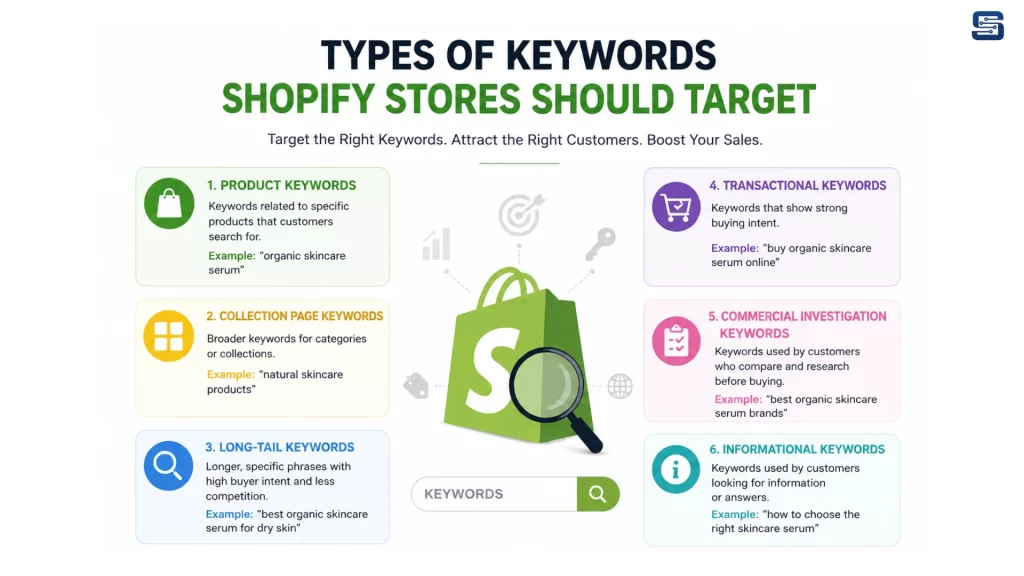
A professional Shopify SEO strategy should include different keyword types based on user intent.
1. Product Keywords
Product keywords are directly related to the items you sell. These keywords are usually used by people who already know what they want.
Examples:
- “organic cotton t-shirt”
- “gold-plated bracelet”
- “wireless charging lamp”
- “vegan leather handbag”
- “Shopify product keyword research”
These keywords are best used on product pages, product titles, product descriptions, image alt text, and product schema.
2. Collection Page Keywords
Collection page keywords are broader than product keywords. They usually target a product category rather than one specific item.
Examples:
- “women’s bracelets”
- “men’s leather wallets”
- “home office furniture”
- “skincare products”
- “Shopify collection page keywords”
Collection pages should not be thin product grids only. For better SEO, add a short optimized introduction, helpful buying guidance, internal links, FAQs, and unique category content.
3. Long-Tail Keywords
Long-tail keywords are longer and more specific search phrases. They usually have lower search volume but stronger intent.
Examples:
- “best waterproof hiking backpack for travel”
- “affordable handmade silver bracelets for women”
- “how to choose the right Shopify theme for fashion store”
- “best keywords for Shopify product pages”
Long-tail keywords are powerful for Shopify stores because they help attract customers who know exactly what they are looking for.
4. Transactional Keywords
Transactional keywords show that the user is close to making a purchase. These keywords often include terms like “buy,” “price,” “discount,” “deal,” “coupon,” “near me,” “free shipping,” or “for sale.” Transactional ecommerce keywords are important because they connect your store with customers who are ready to take action.
Examples:
- “buy handmade candles online”
- “silver bracelet price”
- “organic skincare discount”
- “buy leather wallet with free shipping”
5. Commercial Investigation Keywords
These keywords are used when customers are comparing options before buying.
Examples:
- “best Shopify SEO tools”
- “Shopify vs WooCommerce for ecommerce”
- “best running shoes for flat feet”
- “top skincare brands for sensitive skin”
- “best keyword research tools for Shopify”
These keywords are useful for blog posts, comparison pages, buying guides, and educational content.
6. Informational Keywords
Informational keywords are used by people looking for guidance, education, or answers.
Examples:
- “what is Shopify keyword research”
- “how to do keyword research for Shopify stores”
- “how to optimize Shopify product pages”
- “why Shopify SEO is important”
- “how to find ecommerce keywords”
These keywords are best for blog articles, guides, FAQs, and resource pages.
How to Do Keyword Research for Shopify Stores
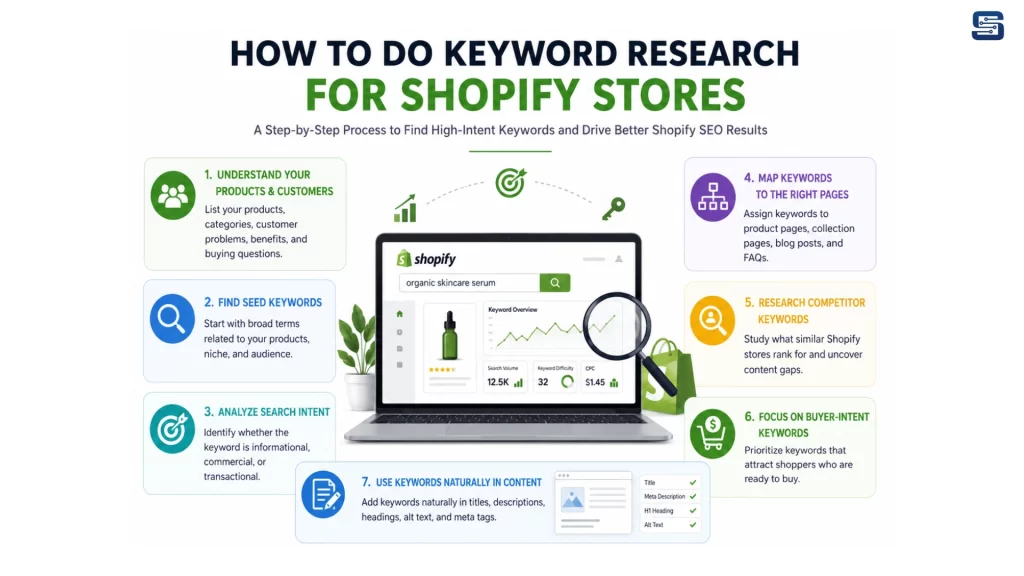
Step 1: Understand Your Products and Customers
Before using any keyword research tool, start with your products and audience. List your product categories, best-selling products, customer problems, product benefits, use cases, sizes, colors, materials, and buyer questions.
For example, if you sell bracelets, you can organize your keyword ideas around:
- Material: silver, gold, gemstone, beaded
- Audience: women, men, couples, gifting
- Occasion: birthday, anniversary, wedding, festival
- Style: minimal, luxury, handmade, spiritual
- Intent: buy, price, best, online, gift
This helps you create keyword groups that match real customer behavior.
Step 2: Find Seed Keywords
Seed keywords are basic keywords related to your product or niche. These are the starting points for deeper research.
Examples for a Shopify fashion store:
- “women’s clothing”
- “summer dresses”
- “cotton shirts”
- “designer handbags”
- “fashion accessories”
Examples for a Shopify beauty store:
- “organic skincare”
- “face serum”
- “vitamin C serum”
- “natural moisturizer”
- “anti-aging cream”
Once you have seed keywords, expand them into long-tail and intent-based keywords.
Step 3: Analyze Search Intent
Search intent means the reason behind a search. For Shopify SEO, this is extremely important because every keyword should match the correct page type.
For example:
- “what is vitamin C serum” → blog article
- “best vitamin C serum for oily skin” → buying guide
- “vitamin C serum price” → product or collection page
- “buy vitamin C serum online” → product or collection page
If the keyword intent does not match the page, ranking becomes difficult, and conversions may stay low.
Step 4: Map Keywords to the Right Shopify Pages
Every keyword should have a clear page target. Do not use the same main keyword on too many pages because it can create keyword cannibalization.
Use this structure:
| Shopify Page Type | Best Keyword Type |
|---|---|
| Homepage | Brand + broad business keyword |
| Collection Pages | Category and commercial keywords |
| Product Pages | Product-specific and long-tail keywords |
| Blog Posts | Informational and comparison keywords |
| FAQ Sections | Question-based keywords |
| Landing Pages | Service, offer, or campaign keywords |
For example:
- Homepage: “premium handmade jewelry store.”
- Collection page: “women’s gemstone bracelets.”
- Product page: “amethyst healing bracelet for women.”
- Blog post: “How to choose the right gemstone bracelet.”
- FAQ: “Which gemstone bracelet is best for positive energy”
Step 5: Research Competitor Keywords
Competitor keyword research helps you understand what similar Shopify stores are ranking for. Review their collection pages, product titles, blog topics, meta titles, URL structure, FAQs, and internal linking.
Check:
- Which keywords competitors use in page titles
- Which collection pages rank well
- Which blog topics bring organic traffic
- How they structure product descriptions
- What FAQs they answer
- Which long-tail terms they target
This helps you find keyword gaps and content opportunities.
Step 6: Focus on Buyer Intent Keywords
For Shopify stores, traffic is not enough. The goal is traffic that can convert. Buyer intent keywords usually perform better because they show purchase interest.
Examples:
- “buy organic cotton bedsheets”
- “best laptop bag for office women”
- “affordable gold bracelets online”
- “Shopify SEO expert for ecommerce store”
- “custom Shopify store development services”
These keywords can be used in collection pages, product pages, service pages, and landing pages.
Step 7: Use Keywords Naturally in Shopify Content
After selecting keywords, use them naturally across important SEO areas:
- Page title
- Meta title
- Meta description
- URL slug
- H1 heading
- H2 and H3 headings
- Product description
- Collection description
- Image alt text
- FAQ answers
- Internal anchor text
Shopify advises using readable and unique phrases instead of forcing keywords unnaturally. Keyword stuffing can make content look spammy and reduce user trust.
Where to Use Keywords in a Shopify Store
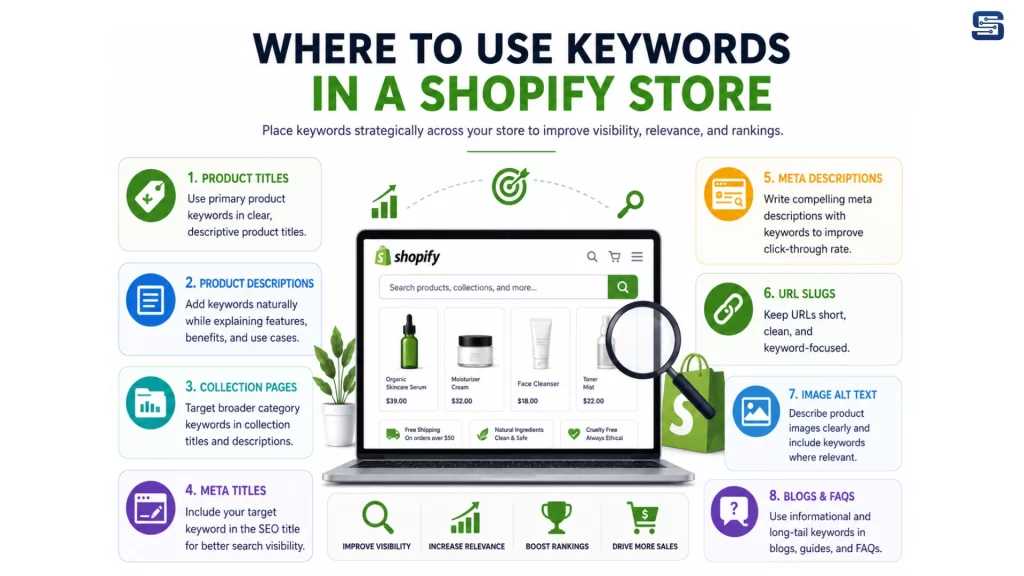
Product Titles :
Product titles should be clear, descriptive, and keyword-focused.
Weak title:
“Bracelet 101”
Better title:
“Handmade Gemstone Bracelet for Women”
Product Descriptions:
Product descriptions should include keywords, but they should also explain benefits, materials, use cases, size, care instructions, and trust factors.
Example:
“This handmade gemstone bracelet is designed for women who love elegant, meaningful jewelry. Made with polished natural stones, it is ideal for daily wear, gifting, meditation, and spiritual styling.”
Collection Pages:
Collection pages should include a short SEO-friendly introduction before or after the product grid.
Example:
“Explore our collection of women’s gemstone bracelets designed for everyday elegance, gifting, and spiritual wellness. Choose from amethyst, rose quartz, citrine, and other natural stone bracelets crafted for comfort, style, and meaning.”
Blog Content:
Blogs help you target informational and comparison keywords.
Blog topic examples:
- “How to Do Keyword Research for Shopify Stores”
- “Best Shopify SEO Tips for Ecommerce Growth”
- “How to Optimize Shopify Product Pages for Google”
- “Shopify Collection Page SEO Best Practices”
- “Product Page SEO Checklist for Shopify Stores”
Shopify’s 2026 SEO checklist emphasizes keyword research, on-page optimization, technical fixes, and content improvements as part of a complete SEO approach.
Image Alt Text
Image alt text should describe the image clearly and include keywords only when relevant.
Weak alt text:
“image1”
Better alt text:
“handmade gemstone bracelet for women”
Common Keyword Research Mistakes Shopify Store Owners Make
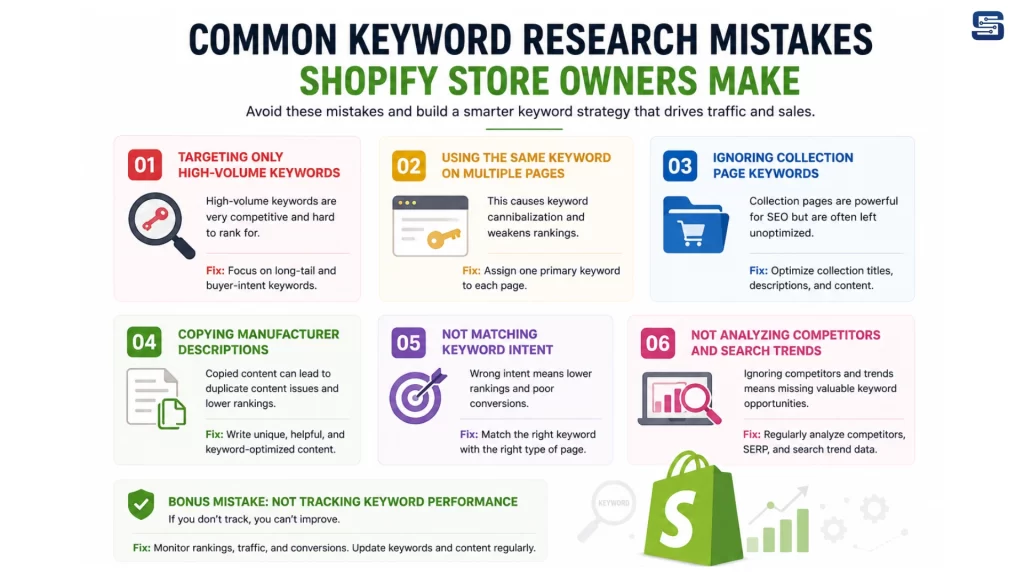
1. Targeting Only High-Volume Keywords
High-volume keywords are usually more competitive and broad. A new or growing Shopify store may rank faster by targeting long-tail, product-specific, and buyer-intent keywords.
2. Using the Same Keyword on Multiple Pages
If multiple pages target the same keyword, Google may not know which page to rank. This is called keyword cannibalization. Each important keyword should have one main target page.
3. Ignoring Collection Page SEO
Many Shopify stores leave collection pages with only product grids and no optimized content. This is a missed opportunity because collection pages can rank for valuable category keywords.
4. Copying Manufacturer Product Descriptions
Copied product descriptions can create duplicate content issues because the same text may appear on many websites. Shopify recommends writing unique product and collection descriptions.
5. Not Matching Keyword Intent
A blog post cannot always rank for a transactional product keyword, and a product page may not rank well for an informational keyword. Match the page format to the search intent.
Example Keyword Mapping for a Shopify Store
| Homepage | Shopify jewelry store | handmade jewelry online, premium jewelry store |
| Collection Page | women’s gemstone bracelets | natural stone bracelets, healing bracelets for women |
| Product Page | amethyst bracelet for women | handmade amethyst bracelet, purple gemstone bracelet |
| Blog Post | how to choose gemstone bracelets | best gemstone bracelet, gemstone meaning guide |
| FAQ Section | which bracelet is best for gifting | bracelet gift ideas, jewelry gift for women |
Best Keyword Research Tools for Shopify Stores:
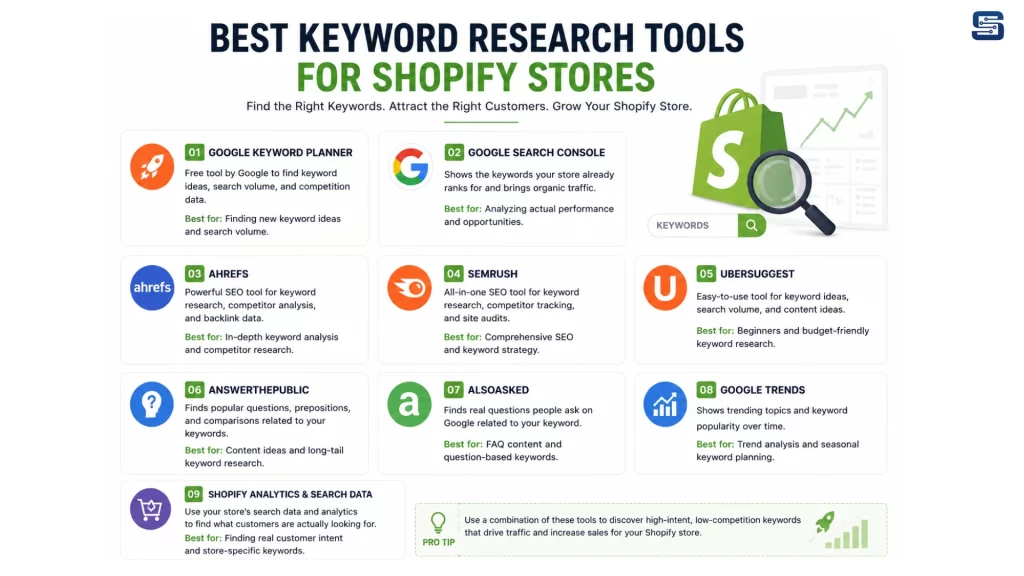
You can use different tools to find keyword ideas, search volume, difficulty, and competitor opportunities.
Useful tools include:
- Google Keyword Planner
- Google Search Console
- Google Trends
- Ahrefs
- SEMrush
- Ubersuggest
- AnswerThePublic
- AlsoAsked
- Google autocomplete
- Shopify analytics and site search data
Google Search Console is especially useful after your store has started getting impressions because it shows the real keywords people use to find your pages.
Professional Shopify Keyword Strategy:
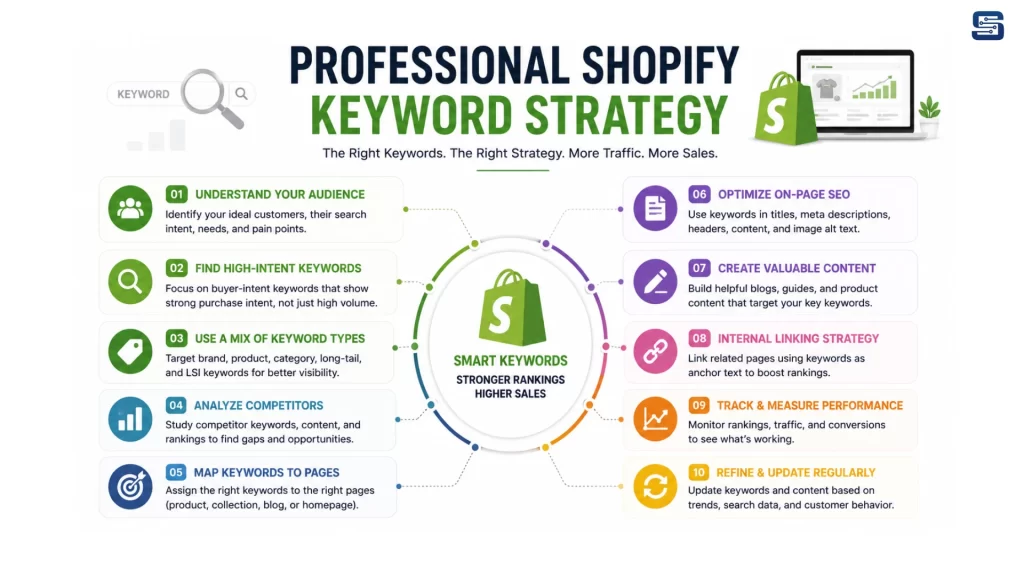
A complete Shopify keyword strategy should include:
- Homepage keyword plan
- Collection page keyword mapping
- Product page keyword mapping
- Blog topic clusters
- FAQ keyword opportunities
- Internal linking structure
- Meta title and description optimization
- Image alt text strategy
- Competitor keyword gap analysis
- Monthly keyword performance tracking
This approach helps your Shopify store build topical authority, improve rankings, and attract customers at every stage of the buying journey.
Conclusion
Keyword research is the key to getting the right customers to your Shopify store. By targeting buyer-intent, product, collection, and long-tail keywords, you can improve visibility, attract quality traffic, and increase sales.
Need help with Shopify SEO content? Startbit IT Solutions can help you rank smarter and grow faster.