

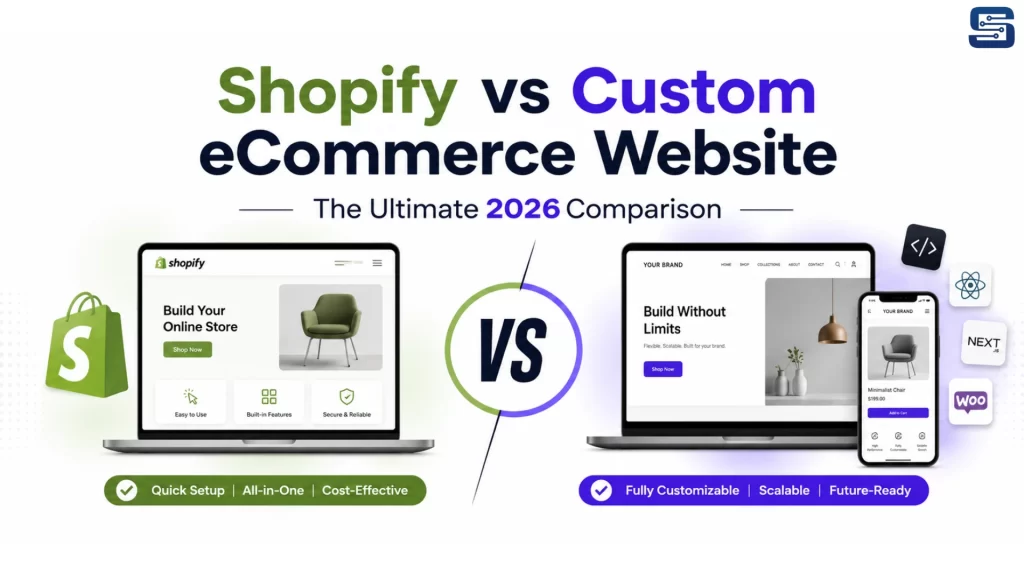
What Is an eCommerce Website?
An eCommerce website is an online store where businesses sell products or services over the internet. Instead of visiting a physical shop, customers can browse products, compare prices, place orders, and make payments online – all in one place.
What makes an eCommerce website different from a normal website is its functionality. A blog shares information. A portfolio shows work. An eCommerce website sells, manages orders, tracks performance, and helps businesses grow by turning visitors into customers.
The Role of Online Stores in Modern Business
Online stores are now the foundation of modern business. What was once optional is now essential. Customers expect fast, convenient, and flexible shopping – and eCommerce delivers exactly that. From small startups to global brands, online stores remove location limits and open the door to a wider audience.
Today, an online store is more than a sales channel. It helps build customer relationships through email marketing, cart recovery, loyalty programs, and personalized offers. Every interaction creates valuable data about what customers like, where they leave, and what drives them to buy.
In 2026, running a business without these insights isn’t realistic. Online stores provide real-time data, helping businesses improve faster and grow smarter. Whether it’s Shopify or a custom eCommerce website, your online store plays a key role in scalability, performance, and long-term success.
Why eCommerce Matters More Than Ever in 2026
By 2026, eCommerce is no longer “the future” – it’s the default. Consumer behavior has permanently shifted toward digital-first buying experiences. People research online, compare online, and often purchase online even if they later pick up in-store. This shift has pushed businesses to rethink how they sell, market, and support customers.
Technology advancements have also raised the bar. Faster internet, mobile-first design, voice search, and AI-driven personalization have changed what customers expect. A slow, clunky store feels outdated instantly. A smooth, intuitive experience feels normal. That’s why choosing the right platform – Shopify or a custom eCommerce website – matters more than ever.
In 2026, eCommerce success is about agility. Businesses need platforms that can adapt to new payment methods, marketing channels, and customer behaviors. The decision between Shopify and a custom solution isn’t just technical; it’s strategic. It affects how fast you can launch, how far you can scale, and how uniquely you can position your brand in a crowded digital marketplace.
Shopify vs Custom Website – Key Differences
Purpose and Use Cases
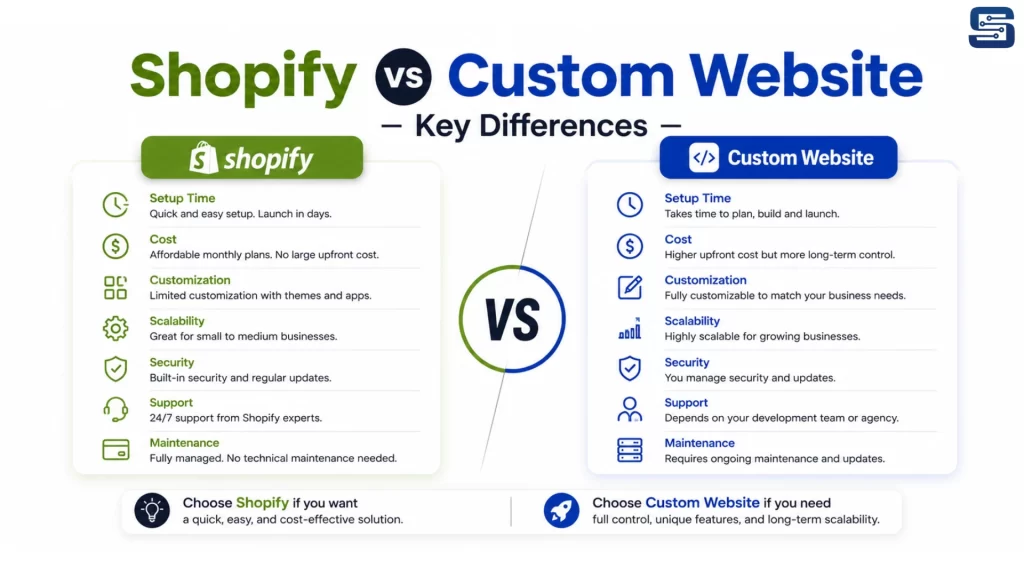
The first major difference between Shopify and a custom eCommerce website lies in purpose. Shopify is designed for speed, simplicity, and accessibility. It’s built for entrepreneurs, small businesses, and even large brands that want to launch quickly without worrying about technical complexity. Shopify’s purpose is clear: make selling online easy.
A custom eCommerce website, on the other hand, is built for flexibility and control. It’s designed to meet specific business requirements that off-the-shelf platforms can’t always handle. Custom solutions are often chosen by businesses with unique workflows, complex product logic, or advanced integrations that go beyond standard features.
Think of Shopify like renting a fully furnished apartment. You move in fast, everything works, but you can’t knock down walls. A custom website is like building your own house. It takes longer, costs more, but every detail is yours. The right choice depends on what your business actually needs – not what sounds more impressive.
Hosting Structure
Shopify is a fully hosted platform. That means hosting, server management, and performance optimization are handled for you. You don’t choose a hosting provider or worry about downtime caused by server issues. Shopify takes care of it behind the scenes.
Custom eCommerce websites require separate hosting. You choose your hosting provider, configure servers, manage performance, and handle scaling. This gives you more control but also more responsibility. If traffic spikes and your server isn’t ready, your site can slow down or crash.
Hosting structure directly affects reliability, speed, and cost. Shopify’s hosted environment offers peace of mind. Custom hosting offers flexibility. In 2026, both approaches can be fast and secure- but only if managed properly.
Ownership & Control
With Shopify, you own your content, products, and brand – but not the platform itself. You’re operating within Shopify’s ecosystem and terms. If Shopify changes pricing, policies, or features, you adapt.
A custom eCommerce website gives you full ownership. You control the code, the infrastructure, and the future of the platform. There’s no dependency on a single provider. This level of control is powerful but comes with added complexity.
Ownership isn’t just legal – it’s strategic. Businesses planning long-term, highly customized growth often lean toward custom solutions. Those prioritizing speed and simplicity often choose Shopify.
Platform Type Explained
Shopify is a SaaS (Software as a Service) platform. You pay a monthly fee to use it. Updates, security patches, and new features roll out automatically.
Custom eCommerce websites are typically built using open-source or proprietary frameworks. They’re not subscription-based in the same way. Instead, you invest in development, hosting, and maintenance separately.
This fundamental difference shapes everything else – costs, scalability, and operational effort. Understanding this sets the foundation for every comparison that follows.
Ease of Setup & Time to Launch
Beginner-Friendly Setup
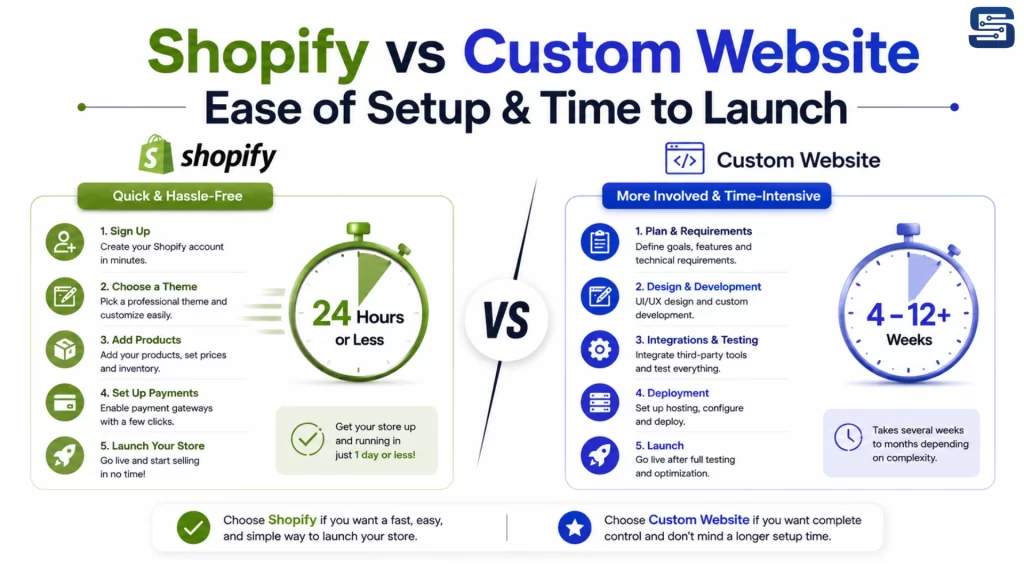
Shopify makes getting started easy, especially for beginners. You don’t need technical skills or coding knowledge. Just sign up, choose a theme, add products, and your store is ready to go. The dashboard is simple, with clear buttons and step-by-step guidance, making setup fast and stress-free.
This ease of use is a big advantage in 2026, where launching quickly can make a real difference. Solo founders and small businesses can focus on selling instead of technical setup.
A custom eCommerce website is very different. It requires planning, technical decisions, development, and testing. Even with experts, setup takes more time and effort. For beginners, this process can feel complex and overwhelming.
Development Timelines Compared
Time to launch is where Shopify clearly stands out. With Shopify, a store can go live in days – or even hours. If products and branding are ready, businesses can launch quickly, test ideas, and start selling without long delays.
Custom eCommerce websites take much longer. Development often takes weeks or months due to planning, custom features, and testing. While this results in a tailored solution, it delays entering the market and capturing opportunities.
In 2026, speed equals relevance. Shopify supports fast launches and quick validation, while custom websites are better suited for businesses that prioritize customization over speed.
Technical Skill Requirements
Shopify requires minimal technical skills. Most users can manage their stores independently after a short learning curve. Even advanced customizations often rely on apps rather than custom code. This empowers business owners to stay hands-on without relying heavily on developers.
Custom eCommerce websites demand technical expertise. Whether it’s in-house developers or external agencies, ongoing technical involvement is almost guaranteed. Updates, bug fixes, and feature enhancements all require coding knowledge. For businesses with strong technical teams, this isn’t a drawback—it’s a strength. But for others, it can become a bottleneck.
Does Shopify Create Your Website for You?
What “Hosted Solution” Really Means
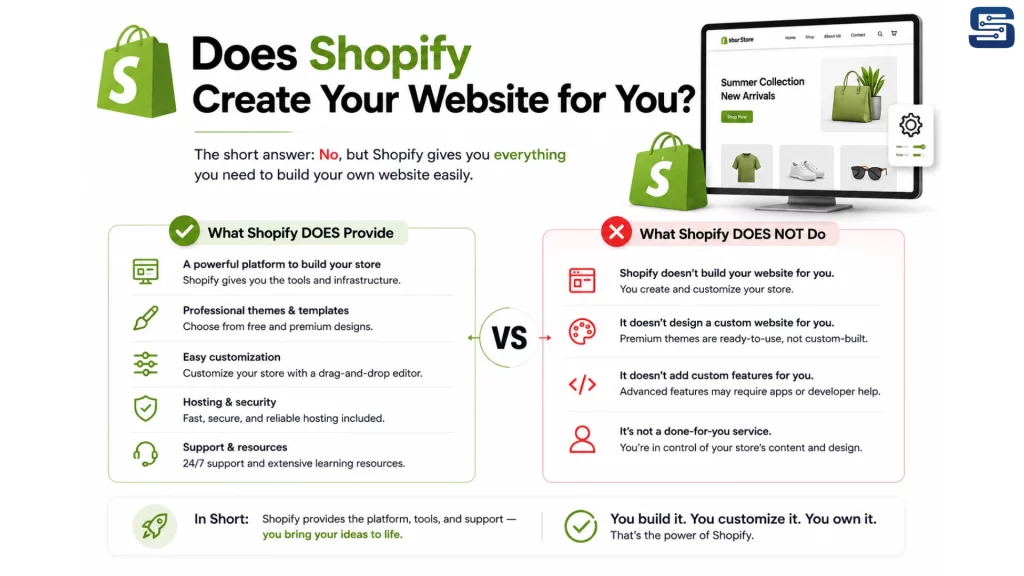
A common question is whether Shopify actually creates your website for you. The short answer: Shopify provides the framework, not the finished masterpiece. As a hosted solution, Shopify gives you the infrastructure, tools, and templates needed to build your store, but you still shape the final result.
Being hosted means Shopify takes care of servers, performance optimization, backups, and security. You don’t install software or manage hosting accounts. Everything lives inside Shopify’s ecosystem. This removes a massive technical burden and allows you to focus on selling rather than maintaining infrastructure.
In 2026, hosted solutions like Shopify have become even more appealing as security threats and performance expectations increase. Letting a specialized platform handle these responsibilities reduces risk and stress.
What You Still Need to Customize
Even though Shopify simplifies the process, it doesn’t magically create a unique brand identity for you. You still need to choose a theme, customize layouts, upload product images, write descriptions, and configure settings. Think of Shopify as a fully stocked kitchen – you still need to cook the meal.
Customization on Shopify is guided and structured. You work within predefined sections and options. For most businesses, this is more than enough. You can create a professional, conversion-focused store without touching code. Apps extend functionality even further, covering everything from reviews to subscriptions.
Custom websites offer no such structure. Every element must be designed and built. This allows total creative freedom but also requires clear vision and technical execution.
Custom Website: From Scratch Reality
Building a custom eCommerce website means starting from a blank canvas. There are no templates unless you create them. Every button, animation, and workflow must be designed and developed. This approach is powerful but demanding.
The “from scratch” reality often surprises business owners. Decisions that Shopify makes for you – like checkout flow or mobile optimization – must be handled manually. While the end result can be highly unique, the process is longer and more complex.
Design & Customization — Shopify vs Custom
Themes and Templates
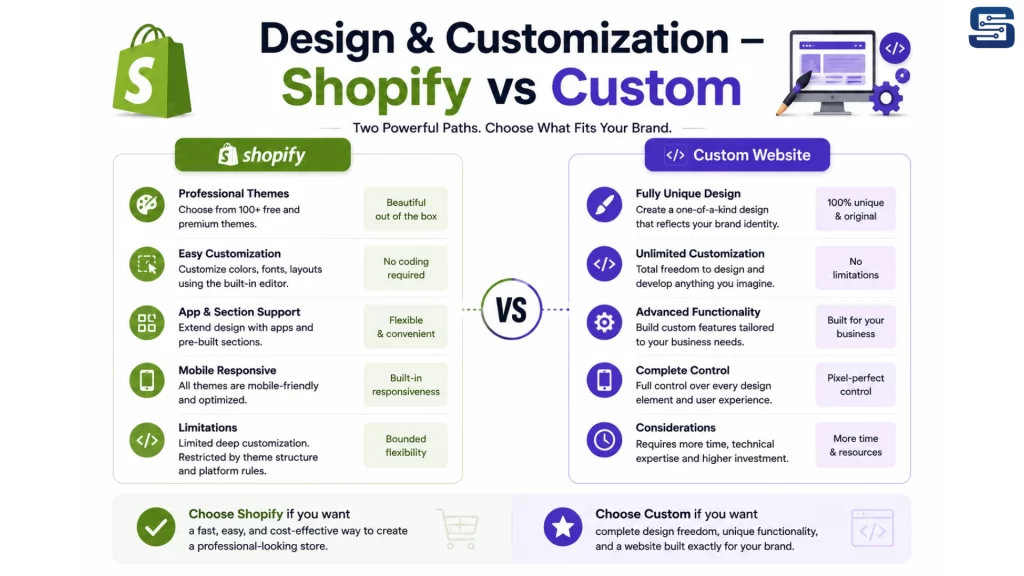
Design is often the first thing customers notice, and in 2026, first impressions matter more than ever. Shopify uses a theme-based design system with professionally built, mobile-friendly, and conversion-optimized themes. These themes work smoothly with Shopify’s platform, reducing design issues and improving performance.
For most businesses, Shopify themes are more than enough. You can easily customize colors, fonts, layouts, and sections without coding, helping brands look polished and trustworthy from day one.
Custom eCommerce websites offer full design freedom. Layouts are built from scratch based on brand identity and user experience goals. While this allows complete creativity, it also requires more time, planning, and design expertise.
Customization Limits on Shopify
While Shopify offers flexibility, it does have boundaries. You’re working within a structured system. Certain elements – like checkout customization – are limited unless you’re on higher-tier plans. Deep backend logic changes often require apps or custom development using Shopify’s templating language.
For many businesses, these limits are not deal-breakers. In fact, they often prevent overcomplication. Shopify’s constraints encourage best practices, ensuring stores remain fast, secure, and user-friendly. However, for brands with highly specific design or functional requirements, these limitations can feel restrictive.
Unlimited Design Freedom with Custom Builds
Custom eCommerce websites offer complete design freedom. You can build any layout, animation, or interaction you imagine. There are no platform rules to follow. This is ideal for brands that want to stand out visually or create unique user journeys.
That freedom comes with responsibility. Without constraints, poor design decisions can hurt usability and conversions. Custom design requires experienced designers and constant testing to ensure the site performs as well as it looks.
Cost Comparison: Shopify Fees vs Custom Development
Upfront Costs
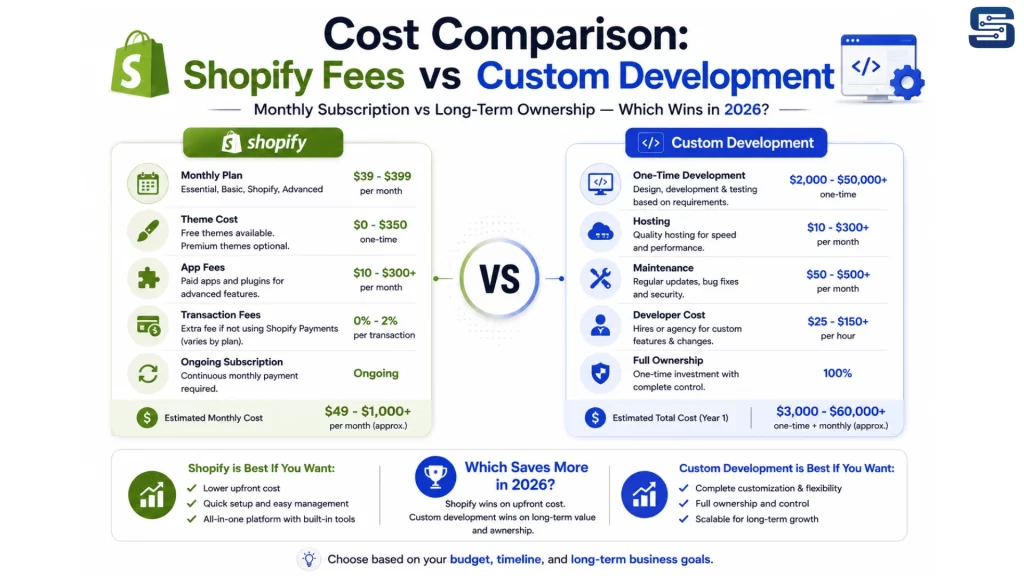
Shopify’s upfront costs are minimal. You pay a monthly subscription and optionally invest in a premium theme or paid apps. This makes budgeting predictable and accessible, especially for small businesses.
Custom eCommerce websites often require significant upfront investment. Design, development, testing, and deployment can cost thousands – or even tens of thousands – before the site goes live. This investment can be worthwhile, but it’s not lightweight.
Monthly & Recurring Expenses
Shopify operates on a subscription model. Monthly fees cover hosting, security, and platform access. Additional costs may include apps and transaction fees. While these expenses add up over time, they’re predictable.
Custom websites incur hosting costs, maintenance fees, security updates, and potential developer retainers. Monthly costs vary depending on complexity and traffic. Over time, custom solutions can become more expensive than Shopify if not managed carefully.
Long-Term ROI Considerations
Shopify offers faster ROI due to quicker launch and lower initial costs. Custom websites may deliver higher long-term ROI for large-scale businesses with unique needs. The “better” option depends on scale, strategy, and patience.
Third-Party Services & Integrations
Shopify App Ecosystem
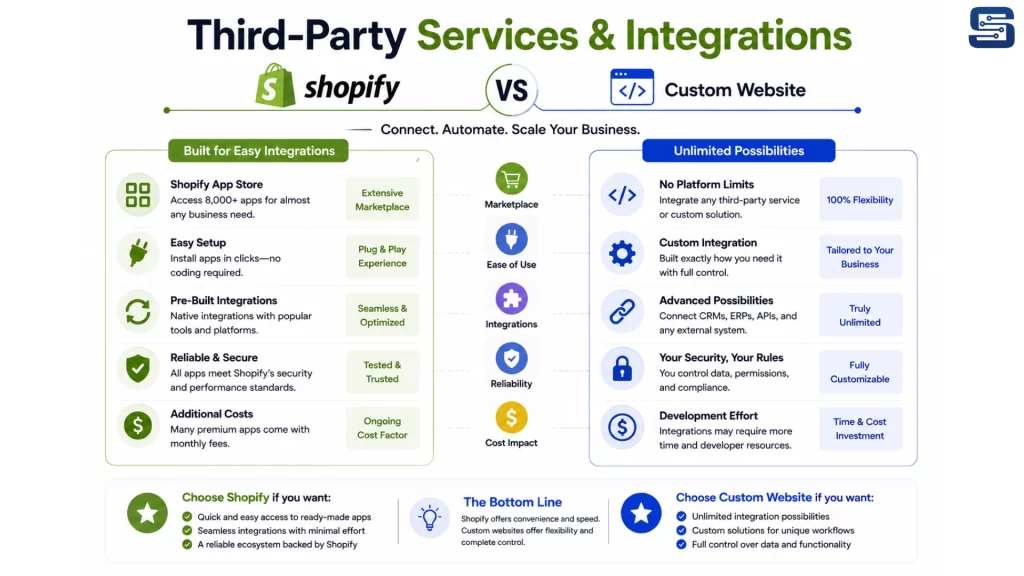
Shopify’s app ecosystem is massive. Thousands of apps extend functionality without custom coding. From email marketing to inventory management, there’s an app for almost everything. PageFly and similar tools allow advanced page customization while staying within Shopify’s system.
Custom Integrations & APIs
Custom websites rely on APIs and direct integrations. This allows deeper, more tailored connections with third-party services. While powerful, integrations require development and maintenance.
Flexibility vs Simplicity
Shopify favors simplicity and speed. Custom websites favor flexibility and control. The right balance depends on business complexity.
Maintenance, Security & Updates
Who Handles What on Shopify
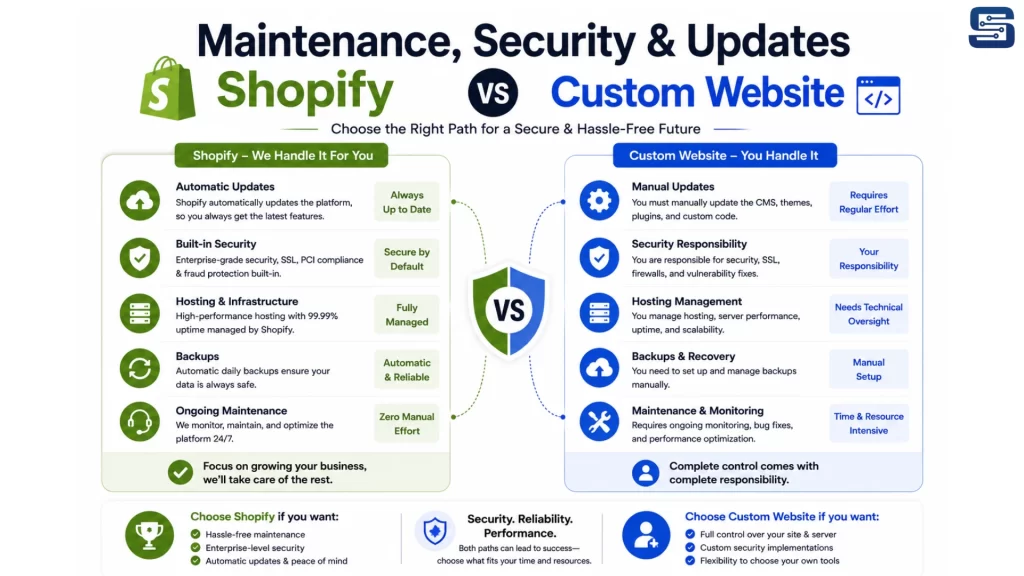
Shopify handles maintenance, updates, backups, and security. You don’t worry about patches or vulnerabilities. This peace of mind is invaluable for non-technical teams.
Custom Website Maintenance Responsibilities
Custom websites require active maintenance. Updates, bug fixes, and security patches are your responsibility. Neglect can lead to performance issues or security risks.
Security Implications
Shopify includes SSL, PCI compliance, and ongoing security monitoring. Custom websites can be equally secure, but only with proper investment and expertise.
Customer Support & Resources
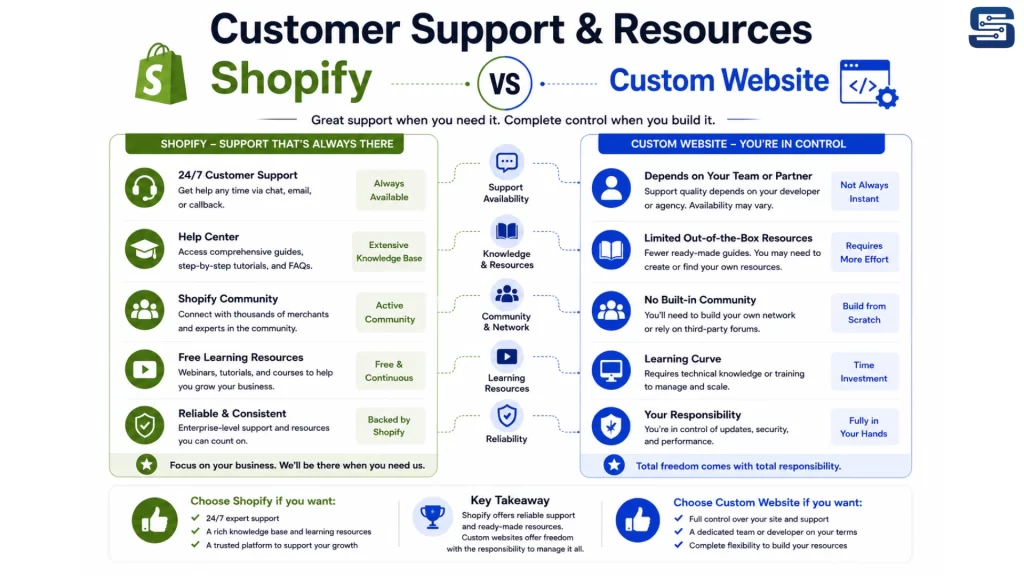
- Shopify Support Channels: Shopify offers 24/7 support, documentation, forums, and tutorials. Help is always available.
- Custom Website Support Options: Support depends on your developer or agency. Response times and quality vary.
- Learning Curves Compared: Shopify’s learning curve is gentle. Custom platforms require a deeper technical understanding.
SEO & Conversion Performance
- Built-in SEO Capabilities: Shopify includes SEO-friendly URLs, meta tags, and site speed optimization. It’s beginner-friendly and effective.
- Custom SEO Flexibility: Custom websites allow full control over SEO structure. Advanced strategies are easier to implement but require expertise.
- Impact on Conversions: Shopify’s optimized checkout boosts conversions. Custom sites can match or exceed this – but only with careful UX design.
Measuring Success – Analytics & Metrics
- Built-in Analytics Tools: Shopify provides dashboards, reports, and integrations with tools like Google Analytics and Campaign Monitor.
- Advanced Tracking Options: Custom websites allow advanced tracking setups but require manual configuration.
- Using Data to Scale: Both platforms support data-driven growth. Shopify makes it easier; custom platforms make it deeper.
How to Choose: Which Is Best for Your Business?
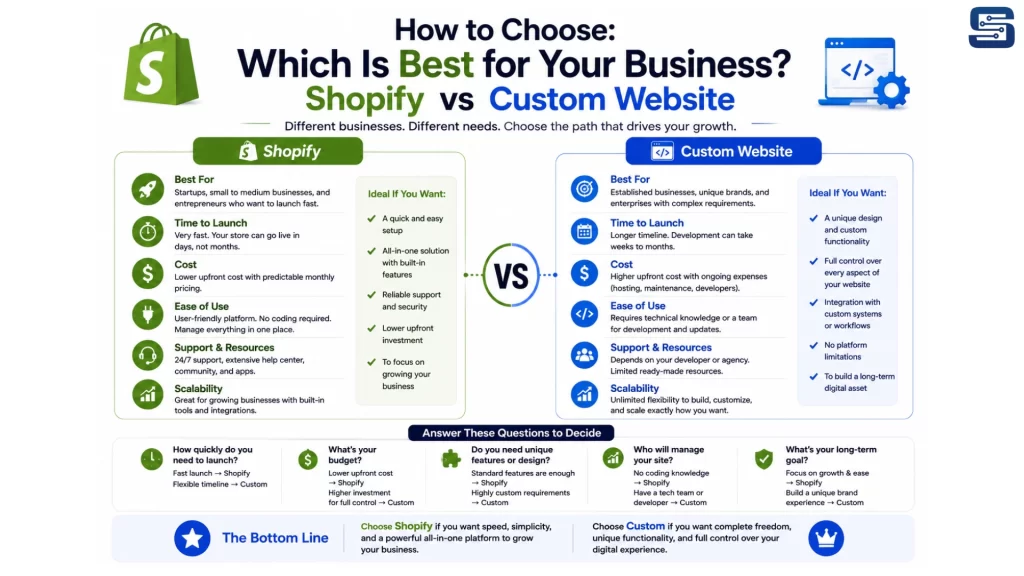
- Budget Considerations: Limited budget? Shopify wins. Large budget with specific needs? Custom may be worth it.
- Growth & Scalability Goals: Shopify scales easily for most businesses. Custom platforms scale best for complex enterprises.
- Technical Skills & Team Resources: No tech team? Shopify. Strong tech team? Custom.
Summary: Pros & Cons of Shopify vs Custom
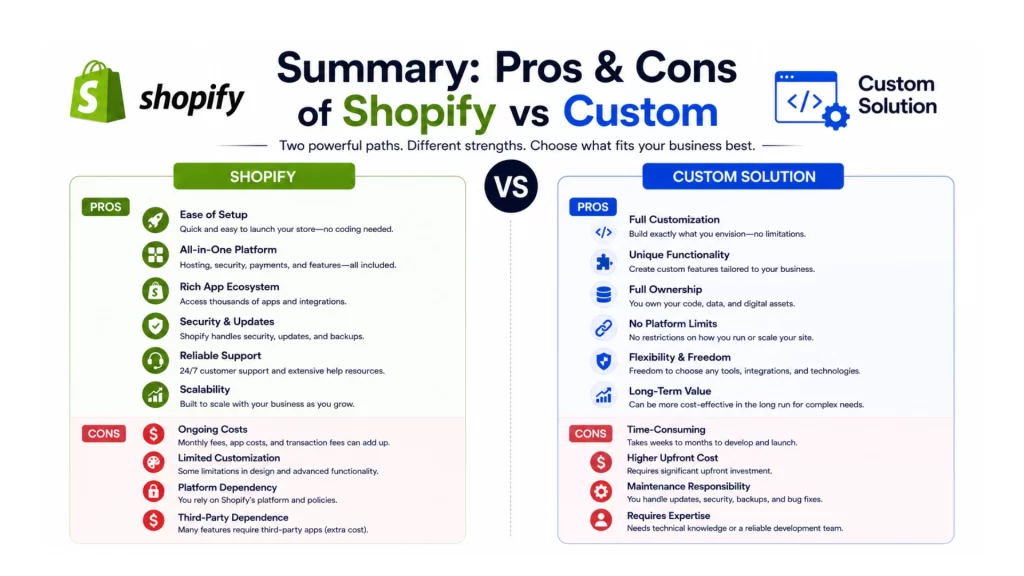
Shopify Pros & Cons
Pros
- Fast setup
- Low upfront cost
- Managed security & hosting
Cons
- Platform limitations
- Ongoing subscription fees
Custom Website Pros & Cons
Pros
- Full control
- Unlimited customization
- No platform dependency
Cons
- High upfront cost
- Ongoing maintenance
Final Recommendation
Choose Shopify if speed, simplicity, and reliability matter most. Choose a custom eCommerce website if control, flexibility, and long-term customization are your priorities. In 2026, success isn’t about the platform – it’s about choosing the one that aligns with your business reality.
Conclusion
Choosing between Shopify and a custom eCommerce website comes down to your goals.
Need speed, simplicity, and quick results? Shopify is your best bet.
Want full control and unlimited customization? Go custom.
The real winner isn’t the platform -it’s how well your store performs.
Not sure what’s right for you? Connect with Startbit IT Solutions for expert guidance and complete eCommerce support.
FAQs
Yes, Shopify is ideal for beginners due to its simplicity and support.
Yes, with the right team and investment, custom sites can outperform Shopify.
Yes, Shopify offers strong built-in SEO features.
They can be, but only with proper maintenance and security expertise.
It depends on scale – Shopify is cheaper early; custom may pay off later.